1. First Pressing, Repressing, Reissue: Three Versions, Three Sounds
The root cause of vinyl version differences lies in the wear of the master tape.
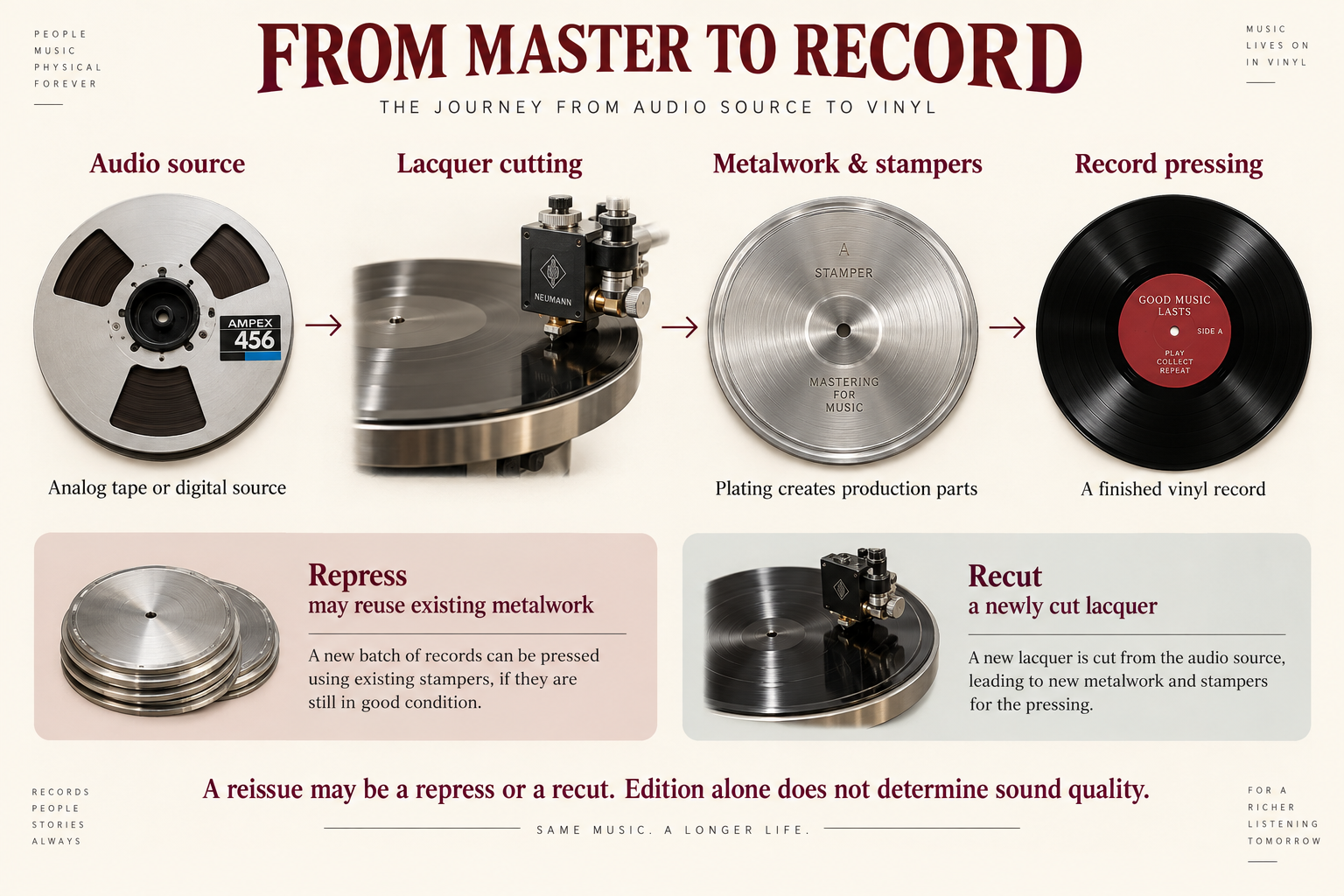
After recording is completed, the master tape must first be cut into a lacquer master, from which a stamper is made, and the stamper is used for mass pressing. Repeated reading of the master tape causes wear. Early recordings often used tape to preserve sound; as tape ages, the magnetic particles shed, and after many playbacks, sound quality noticeably declines. Therefore, versions pressed earlier usually retain more complete information.
The first pressing is the version pressed when the record was first released, usually cut directly from the original master tape, and its sound quality is theoretically closest to the original recording.
A repressing is when, after the first pressing sells out, the record company uses the original lacquer master to press again. But the lacquer master ages and wears, so the pressed records differ from the first version. Some repressings even directly use a lacquer master that has already been used to make stampers, causing greater loss of information.
A reissue is produced by purchasing the master tape or copyright and re-cutting. Reissue quality varies greatly: some are crudely made, with sound quality even worse than old CDs; others have excellent sound and are hard to distinguish from the original.
Easy way to remember: first pressing is the first time, repressing is pressing again with an old lacquer master, and reissue is buying the rights and making it anew.
2. Matrix Numbers: The Record's ID Card
The most reliable way to determine the version is to look at the matrix number engraved on the record's inner groove. On the part of the record near the label where there is no music, shine a flashlight and you can usually see a string of letters and numbers.
Take RCA's matrix number L2 RY 2126-7S as an example:
L: represents the year. In RCA's coding, L corresponds to around 1960.
2: represents an RCA Victor recording.
R: represents classical music; P or T represents popular music.
Y: represents stereo; P represents mono.
2126: the serial number of the recording.
-7S: indicates it comes from the 7th lacquer cut.
To the left of this string, at a 90-degree counterclockwise position, there is also a combination such as A1. The letter represents the stamper batch, with A, B, C, D indicating the 1st, 2nd, 3rd, and 4th times respectively; the number represents the stamper number. Taken together, A1 and 7S mean: from the first stamper batch obtained from the 7th lacquer cut, the first stamper made.
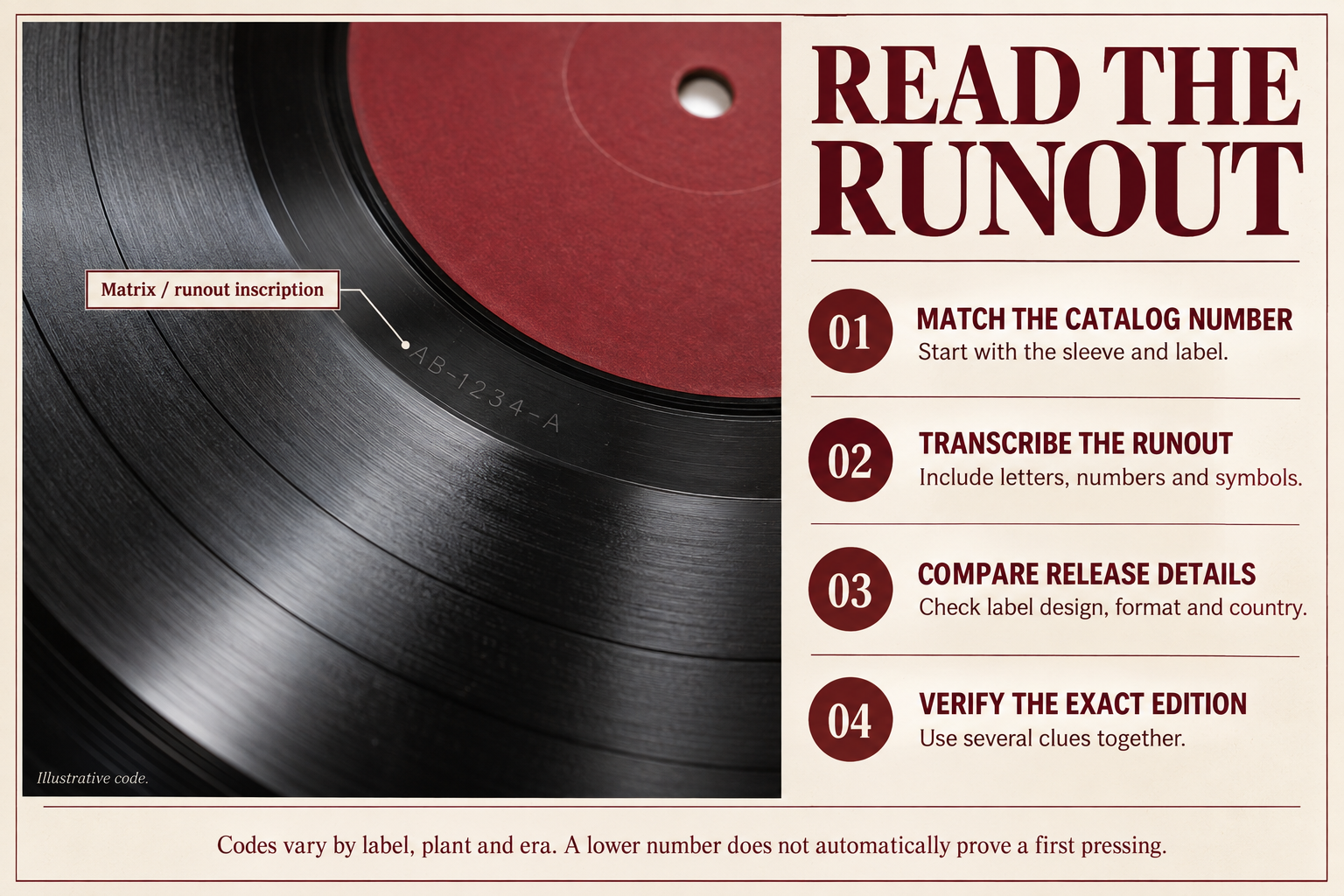
Decca's matrix number format is slightly different. Stereo records often begin with ZAL, representing 12-inch, 33⅓ rpm stereo, followed by a numeric serial number and the cutting engineer's code, for example ZAL-15510-4G.
Columbia's situation is more complex. In the stereo era, matrix numbers often begin with XSM. The numbers in the matrix number refer to the order of the master tape mix, and the letters A through K represent the 1st to 10th lacquer cuts; beyond 10, two letters are used, such as AE for the 15th cut.
Each company's coding rules differ, but the logic is similar: the smaller the numbers and the earlier the letters in the matrix number, the earlier the version usually is.
3. Label Terminology: Big Tulip, Small Tulip, Shadow Dog
Besides the inner groove matrix number, the record label design can also help you quickly determine the version.
Take DG as an example, the most familiar case for classical music lovers.
Records released before 1970 had a ring of blue-and-white tulip patterns on the outermost edge of the label, with a crown made of tulips directly above, called the big tulip version. Starting in 1970, DG changed the label design: the outer blue-and-white tulips were simplified into blue-and-white lines, the crown was reduced, and the company name was simplified, called the small tulip version.
There are further distinctions within the big tulip version. Some sources mention that before 1967, the copyright notice on the label edge was mostly printed in German; from 1967 to 1970 it was changed to English "MADE IN GERMANY." So a big tulip version can be further dated by the language of the copyright notice.
Similar terms include six-eye and two-eye, referring to the number of circular patterns on the label; and the different forms of the dog trademark on RCA Victor labels in different periods, called shadow dog, half-moon dog, and stamp dog. These visual features corroborate with matrix numbers, forming a complete system for vinyl version identification. There are specialized reference books available, such as Vinyl Record Collection Illustrated Guide: LP Player Practical Handbook, which includes a large number of label illustrations.
4. An Easily Misunderstood Version: Japanese Promo Records
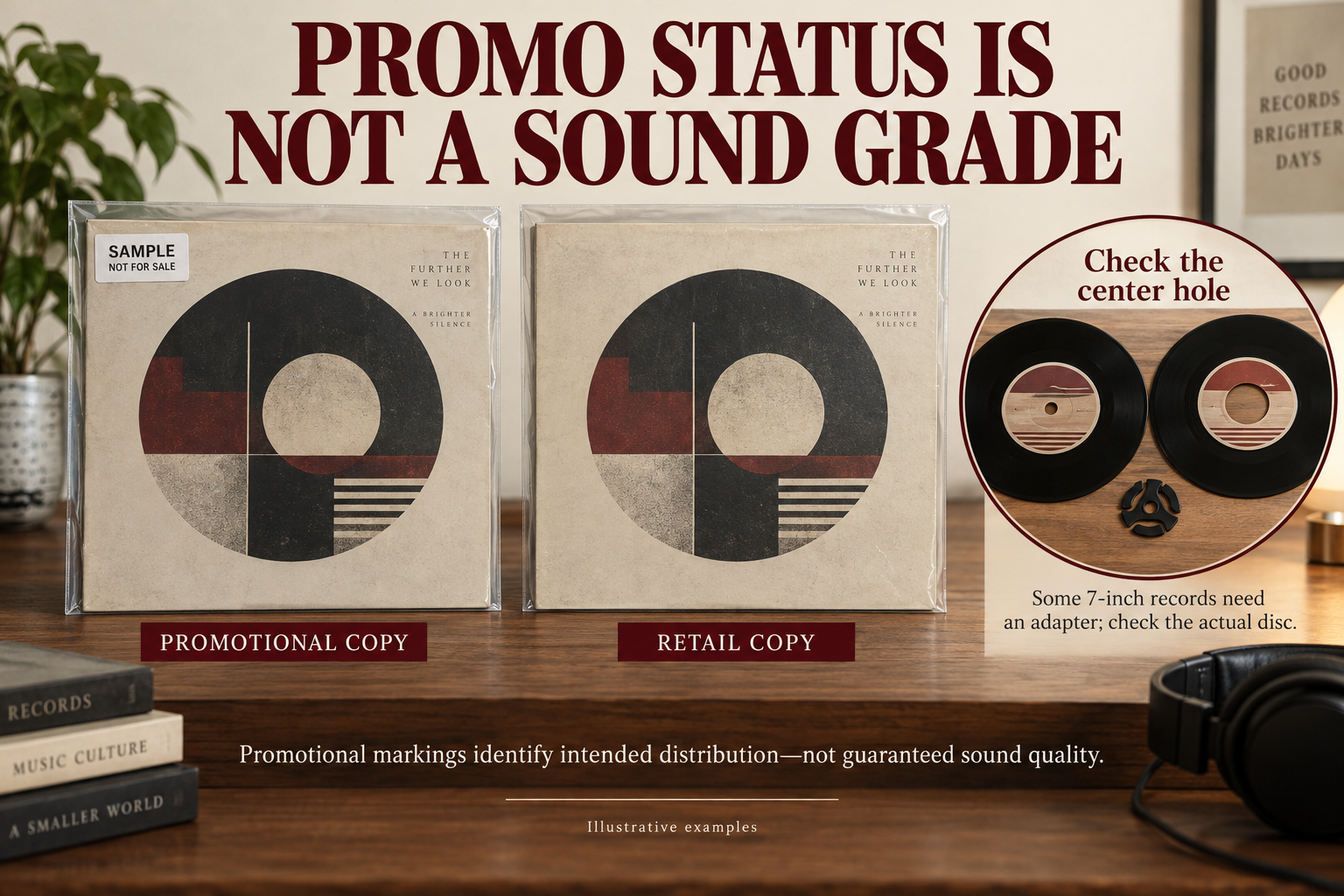
Promo records are a term in the Japanese record industry, referring to samples distributed by record companies to radio stations or record stores for audition before the official release. They use the same lacquer master and production process as the official version; the only difference is that the record is printed with "SAMPLE" or "見本盤" and is prohibited from being sold or given away.
Regarding promo records, two common claims need to be distinguished.
One claim is: promo records are the earliest pressed by the record company, earlier than the so-called first pressing, and theoretically have the best sound quality. Another claim comes from actual comparison: some collectors have listened to the first pressing and promo version of the same version together and found no obvious difference in pressing quality from the same period; 1A1, 1A3, 2A1 are merely differences in batch and production line, not enough to produce an audible difference.
The more reliable conclusion is: promo records are completely identical to the official version in the production process, theoretically possibly slightly earlier, but the actual listening difference is uncertain. Their collectible value comes more from the scarcity brought by "not allowed to circulate" rather than an absolute advantage in sound quality.
One more thing to note: the spindle hole of Japanese 7-inch EP singles is usually larger than standard vinyl and requires an adapter ring to play.
5. Is the First Pressing Always the Best?
Not necessarily.
The first pressing is usually the best in terms of recorded information and has clear matrix number markings, making it easy to identify. But this does not mean the first pressing is the best choice in all cases.
Some record companies adopted new technology improvements in versions after the first pressing, increasing the signal-to-noise ratio and reducing pops, which may actually sound more pleasant. There are also non-first-pressing versions that may use the master tape to directly cut a new vinyl lacquer master; the information content produced this way is the same as the first pressing, but lacks obvious markings and is not easy to identify. RCA, PHILIPS, CBS, and other companies have released such direct-cut-again versions, which may perform on a turntable no worse than the first pressing, yet cost much less.
In addition, whether the first pressing can show its full strength also depends on your playback equipment. If you do not have a good enough turntable, tonearm, and cartridge, the difference between the first pressing and a repressing may not be audible on your system.
So, the first pressing is worth pursuing, but do not be superstitious about it.
6. Practical Advice for Beginners
First, use your phone flashlight to look at the inner groove. The matrix number is the most reliable basis for judgment. Label designs can be faked, but inner groove engravings are hard to imitate.
Second, do not make the first pressing your only goal. The price of a first pressing can be dozens of times that of a repressing. If you just listen daily, a well-conditioned repressing or reissue is completely sufficient, and some reissues even exceed expectations in sound quality.
Third, check the matrix number before buying. Enter the inner groove matrix number or record number into a record database such as Discogs, and you can usually find the specific version, release year, and approximate market price. Spending two minutes to check can avoid wasting money.
Fourth, you can learn about promo records, but there is no need to chase them. Their scarcity is real, but their sound quality advantage is uncertain. If you just like the music itself, a regular version in good condition is enough.
Vinyl versions may look complicated, but grasp three points and you are unlikely to fall into pitfalls: first look at the inner groove matrix number, then look at label features, and finally judge based on price and condition. There is no absolute good or bad version; what suits your listening needs and budget is what matters most.
Note: Some images in this article are AI-generated and used only as examples for explanation; they may not be accurate.