A record listing says “VG+ / VG.” The cover looks attractive, the price fits your budget, and the album has been on your wantlist for months. What should you expect when the needle reaches the groove?
Those letters describe condition. Learning to read them helps you ask better questions before buying—and describe your own records more clearly.
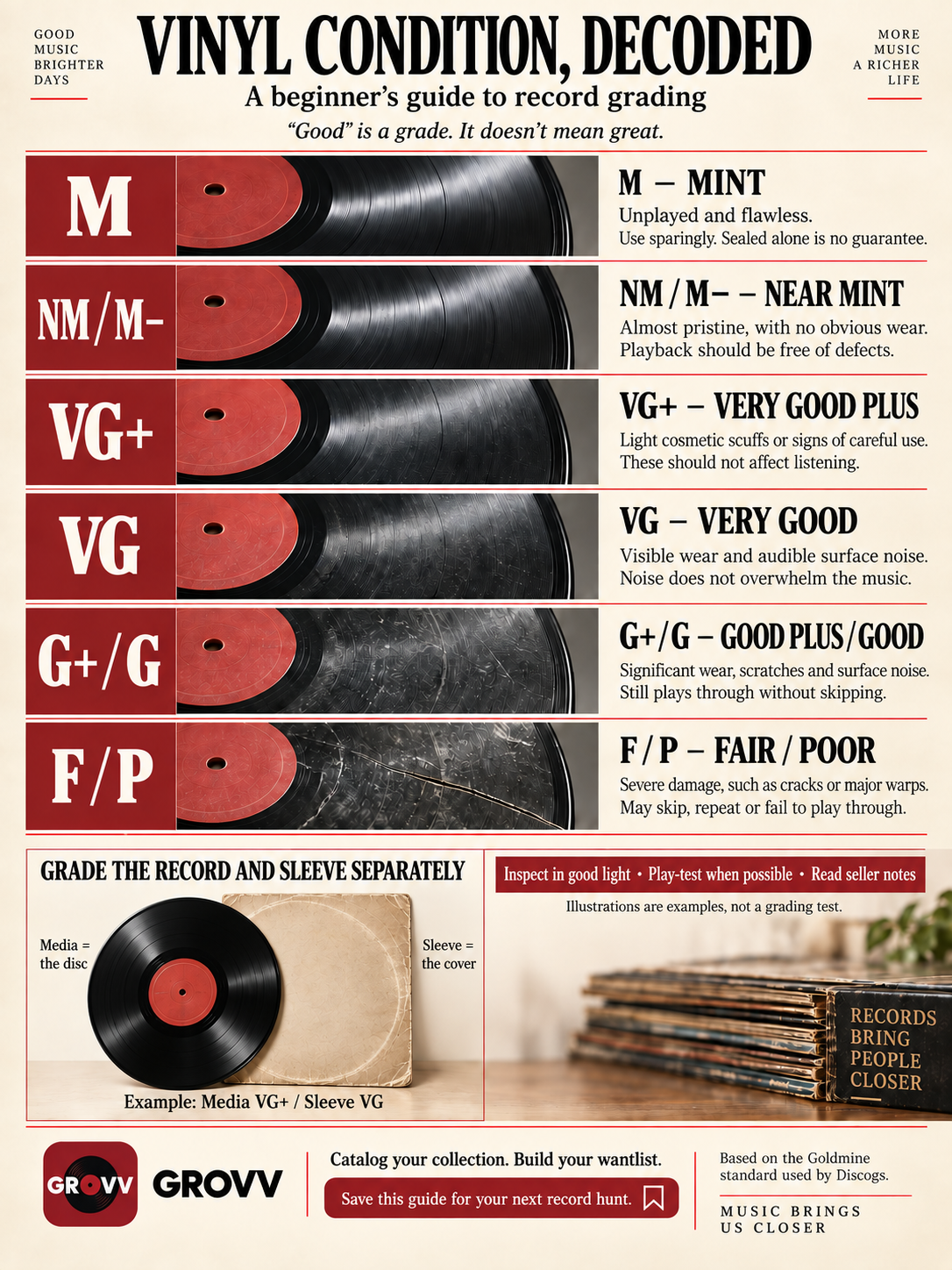
Open the full-size grading guide to read or save it.
Read the scale before the sales pitch
Discogs uses the Goldmine grading standard. These are condition categories, so the everyday meaning of “good” can be misleading. Here is a concise reading of its vinyl definitions. See Discogs: How to Grade Items for the complete criteria.
- Mint (M): Unplayed and flawless. Use this grade sparingly; a sealed package alone does not establish perfection.
- Near Mint (NM or M−): Almost pristine, without obvious wear or playback defects.
- Very Good Plus (VG+): Minor cosmetic marks from careful use, without an adverse effect on listening.
- Very Good (VG): Wear and surface noise are apparent, but the noise does not dominate the music.
- Good Plus (G+) / Good (G): Significant noise and wear, yet the record should play through without skipping.
- Fair (F) / Poor (P): Severe damage; uninterrupted playback may be impossible.
G+ and G remain distinct grades, as do F and P. The illustration groups each pair to keep the overview readable.
VG+ versus VG: the difference you hear
The practical dividing line is whether wear intrudes on playback. A VG+ disc may have minor visible marks. A VG copy has audible wear or noise, which can stand out during quieter music. Goldmine discusses this distinction in its Record Grading 101 guide.
Imagine two listings for the same album. One says “a few faint sleeve marks, play-tested.” Another says “crackle during the opening piano passage.” The second description gives you a specific listening tradeoff to consider. Ask the first seller what the play-test covered rather than assuming the short description tells the whole story.
Your tolerance matters, too. Would occasional noise distract you during an album you play to unwind? Would you accept it on a hard-to-find copy? Decide before the excitement of finding the record makes the decision for you.
The record and sleeve need separate grades
A clean disc can live in a worn jacket. Goldmine treats the record and its packaging separately: ring wear, creases and seam damage concern the cover, while groove condition and playback concern the disc. See its record and cover grading guidance.
When a listing explicitly says Media VG+ / Sleeve VG, it describes a better-preserved disc inside a more worn cover. If you see only “VG+ / VG,” check the field labels rather than guessing their order.
Ask about anything else that matters to you: the original inner sleeve, an insert, a poster or an obi. Make a short list of what you expect to receive. A condition abbreviation is too small to describe every component of a release.
A photograph cannot tell you everything
Visual inspection and listening answer different questions. Goldmine recommends looking carefully at condition and discusses the value of play grading; glossy appearance by itself is not a complete playback assessment. Its grading guide explains the inspection process.
Treat the pictures in our infographic as illustrations, not reference samples to match scratch for scratch. Lighting and reflections change what a photograph reveals. The most useful follow-up is specific: “Have both sides been played all the way through?”
For a purchase you care about, these questions make a useful starting point:
- Is this a visual grade, a play grade, or both?
- Were both sides checked in full, or only selected passages?
- Are there repeating clicks, distortion, skips or sections with pronounced crackle?
- Can you show the labels, sleeve corners and spine clearly?
- Which inserts are included, and what is their condition?
Keep the seller’s answers with the listing while deciding. If the description and photographs leave an important question unresolved, ask about that point directly.
Give the next find a place in your collection
Before browsing, separate the albums you already own from the ones you still want. GROVV lets you catalog your collection and build a wantlist, giving the next record hunt a little more focus.
For a walkthrough, read how to manage vinyl records with GROVV. Use the grading guide alongside a seller’s detailed description and your own listening priorities: the aim is to know what you are bringing home.