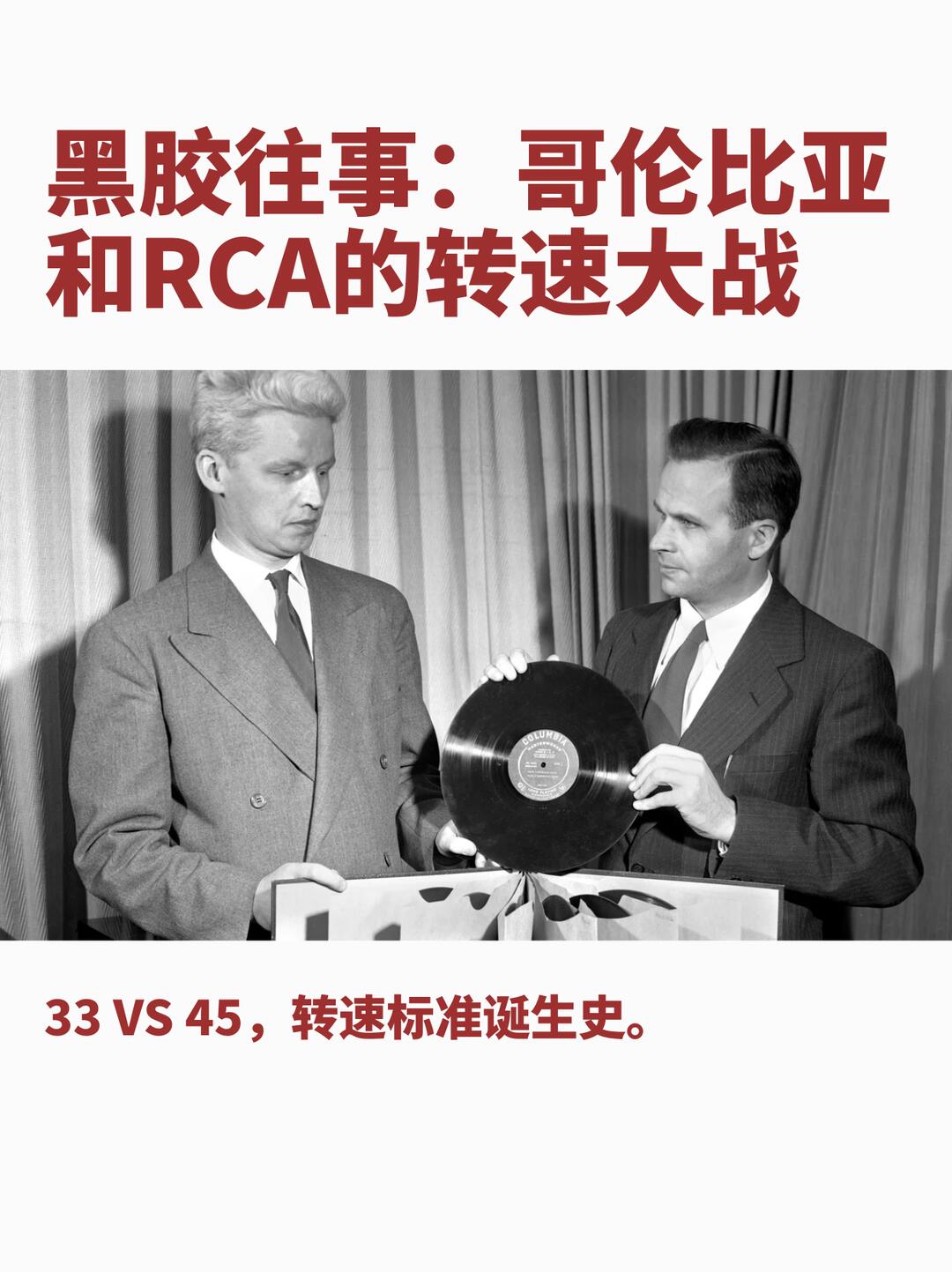
A couple of days ago, while playing a record, I noticed that beside the turntable’s default 33 RPM button sat a 45 RPM button I almost never pressed. I became fixated on those two numbers and wanted to get to the bottom of them. That is how today’s story came about.
As before, the information in this story comes from the internet, books and other sources. If anything is inaccurate, corrections in the comments are welcome.
From the Great Depression to postwar technological innovation
In the autumn of 1945, the smoke over Europe’s battlefields was slowly clearing. A new world order was gradually taking shape on the ruins of war.
The Hungarian-born engineer Peter Carl Goldmark, the brilliant engineer who invented colour television, was conducting an experiment at Columbia Records’ Manhattan headquarters — an experiment that would change the entire music industry.
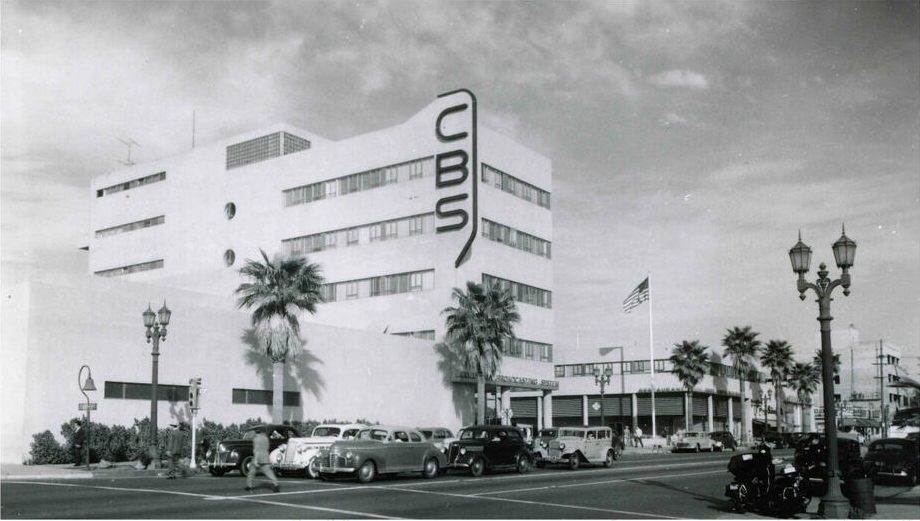
Goldmark faced a seemingly simple but extraordinarily difficult challenge: how could a single record play an entire symphony continuously, instead of requiring the listener to get up and change discs every four minutes, as existing 78 RPM shellac records did?
This problem had long troubled the classical music world. Imagine wanting to hear Beethoven’s Ninth Symphony in the 1940s. You would need seven heavy 78 RPM records, each holding less than five minutes of music.
Just as you immersed yourself in the music, it would suddenly stop at the movement’s climax, the needle scraping through the final groove with a harsh noise. It was like being woken from a beautiful dream. Reluctantly, you would stand up, carefully lift the extremely fragile shellac disc off the platter, find the next one on your record shelf, align it with the spindle and lower the needle. The music would continue, but I suspect the beautiful dream would be hard to enter again. The dream had been interrupted; the emotional experience so patiently built by the music lay in pieces.
But this was not unexplored technological territory. As early as 1931, RCA Victor had introduced 33 1/3 RPM “Program Transcription” records for radio stations. It was a technologically advanced attempt, but a disastrous commercial failure.
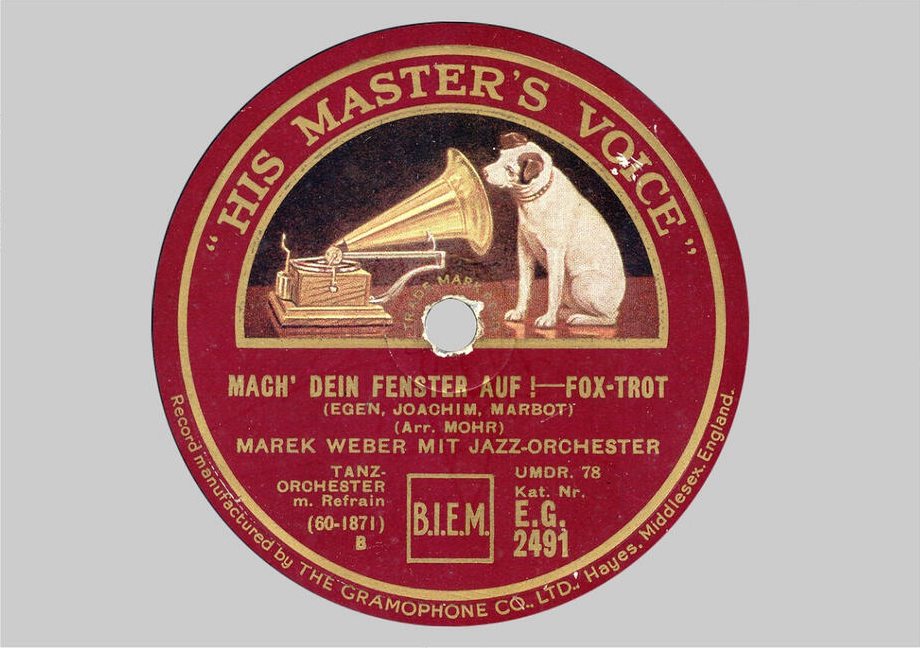
RCA’s failure cannot be blamed entirely on its technical ability. The more important reason was timing. America was living through the Great Depression in the 1930s: 13 million people were unemployed, and in 1932, 34 million lived in households without a regular full-time source of income. Consumers could barely afford food — where would they find spare money for expensive new playback equipment?
Of course, the technology of 1931 was far from mature. The sound was rough and the surface noise unbearable. RCA’s failure made long-playing records almost a taboo throughout the industry. For fifteen years, nobody dared to venture back into the field.
But the world of 1945 was completely different. War had left it scarred and unrecognisable, yet the technological advances driven by that war were unprecedented. These technologies opened new possibilities for technical and industrial innovation across many fields, including records.
The synthetic material polyvinyl chloride (PVC), developed by the military industry, was far tougher and more durable than shellac. Precision engineering from radar and sonar research made exceptionally fine cutting equipment possible. More importantly, America had emerged from the Depression. The wartime dividend brought unprecedented prosperity, a rising middle class and explosive growth in demand for cultural consumption. The time was ripe for a technological transformation of the record industry.
The central challenge Goldmark faced came from the laws of physics. A record’s playing time depends on three variables: its diameter, rotational speed and groove density. A 78 RPM record could hold only about 80–100 grooves per inch, the limit of shellac and the stylus technology of the day. To fit more than twenty minutes of music on a twelve-inch disc required advances on all three fronts: slower rotation to extend playing time, denser grooves to make full use of the surface, and sound quality that improved rather than declined.
In the winter of 1946, the United Nations General Assembly voted to establish its permanent headquarters in New York City, a decision with profound consequences for the city. At roughly the same time, Goldmark’s experiment reached a historic turning point. Using PVC and a new “microgroove” cutting technique, engineers increased groove density to 224–260 per inch — almost three times that of a 78. The new stylus needed just six grams of tracking force rather than the twenty-five grams required by a 78, greatly reducing wear. Slow rotation at 33 1/3 RPM combined with microgroove density meant that the needle travelled nearly half a mile along the groove to play one side of a twelve-inch record — an engineering marvel.
By the summer of 1947, the engineers held their breath as the first test LP played in the laboratory. The first movement of Beethoven’s Fifth Symphony flowed out, clear and with barely perceptible surface noise. Seven minutes... ten minutes... fifteen minutes... the music continued uninterrupted. When the last note faded into silence, the laboratory erupted in cheers. A revolution was coming to the music industry.
Nobody then could have foreseen that this revolution would spark a two-year commercial war and ultimately reshape popular culture throughout the second half of the twentieth century.
June 18, 1948: Mendelssohn’s Violin Concerto in E minor and Columbia’s historic leap
The ballroom of New York’s Waldorf Astoria had always been a stage for power and wealth. On June 18, 1948, however, it witnessed a technological revolution. Columbia Records held a press conference there to show assembled journalists, music critics and industry executives an invention that would “change music history”.
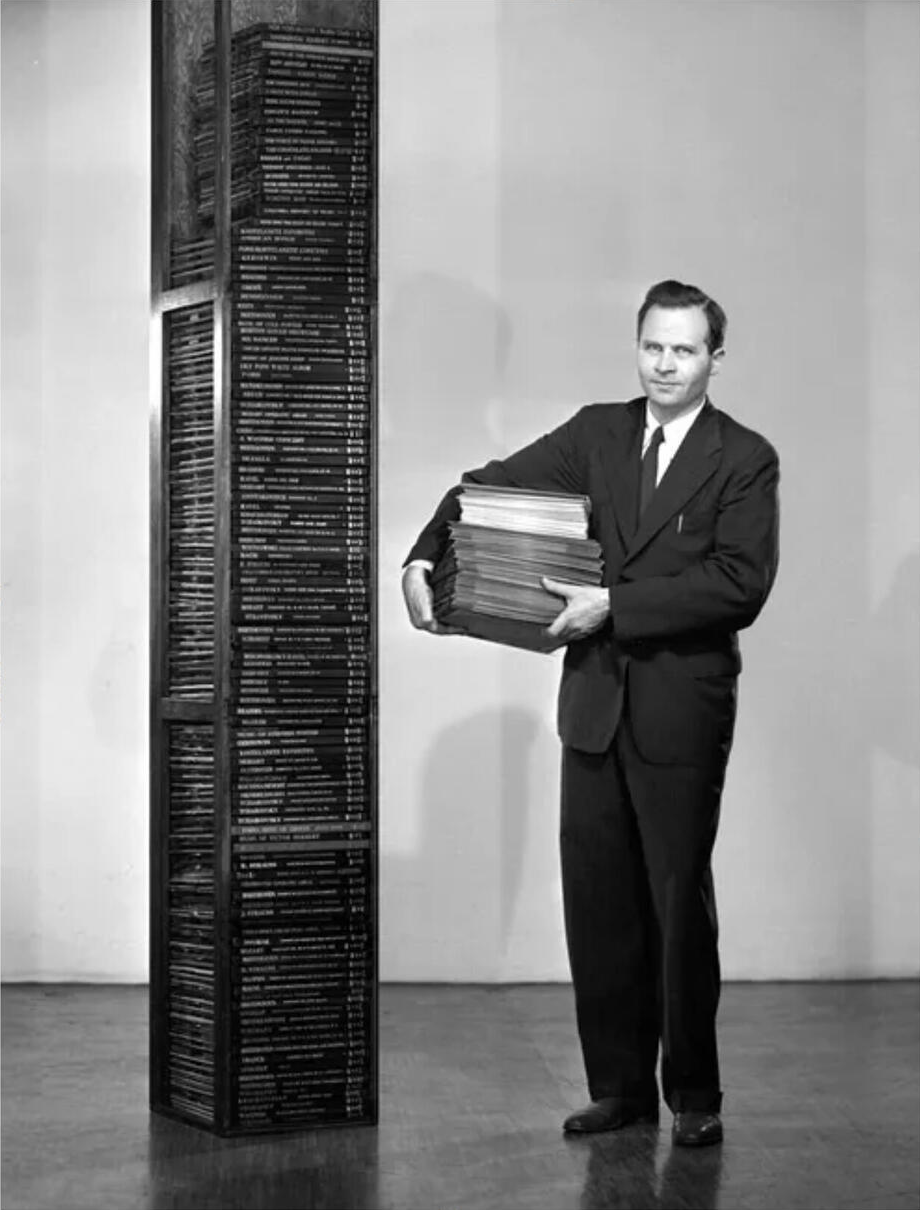
A new record player waited quietly in the centre of the room. Columbia president Edward Wallerstein took the podium, with a stack of 78 RPM records eight feet high behind him. Standing beside that towering stack, he held a small pile of new microgroove records and announced: “Gentlemen, the records in my hands contain as much music as that enormous stack of 78s.” The dramatic contrast stunned the room.
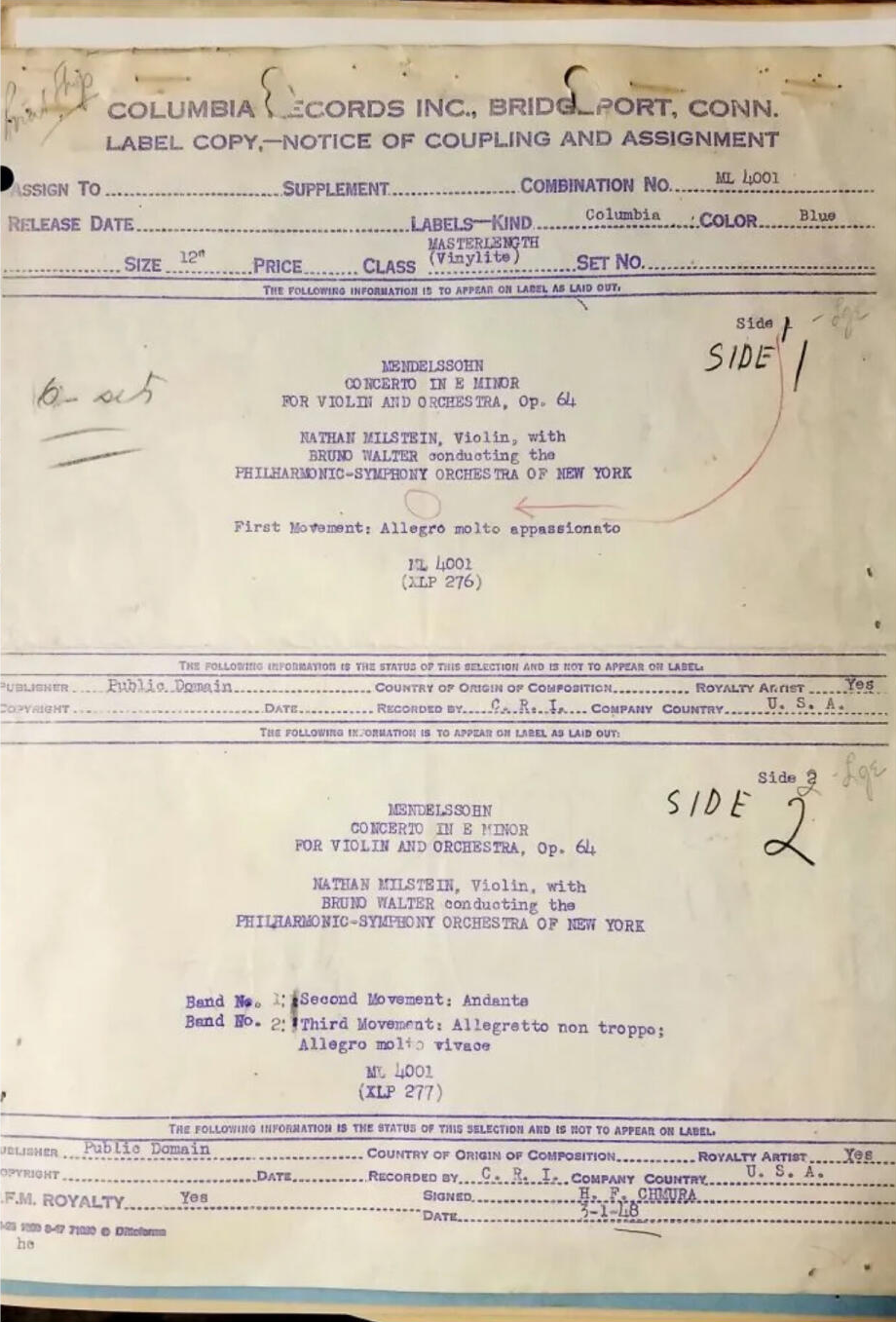
The first microgroove record catalogue was released that same day. Headed by Mendelssohn’s Concerto in E minor, performed by Nathan Milstein with the New York Philharmonic conducted by Bruno Walter (catalogue number ML 4001), its 101 records were predominantly classical works. (Below is the label paperwork for the first microgroove record: the New York Philharmonic recording of Mendelssohn’s Violin Concerto, from the Columbia Records paperwork collection, box 121, folder 3.)
The choice was no accident. Classical music was the LP’s natural home. These listeners understood the value of uninterrupted playback best and were most willing to pay a premium for a high-quality musical experience.
The pricing reflected Columbia’s market strategy: a twelve-inch LP cost $4.85 and a ten-inch LP $2.85, while a set of 78s with the same content could cost six or seven dollars.
The LP offered not only a better experience but better value. This was a classic disruptive-innovation pricing strategy, half a century before Christensen introduced the concept of “disruptive innovation” in The Innovator’s Dilemma in 1997.
Following the spectacular impact of the launch, Columbia made an unprecedented announcement: it would open LP technology to every record company without charging patent royalties.
To consumers, this looked generous. From a business perspective, however, only if the whole industry adopted the same technical standard could Columbia truly become the standard-setter and command the largest market share.
Columbia’s launch and market strategy were gathering momentum, but at RCA Victor’s headquarters south of Central Park in Manhattan, anger, humiliation and a determination never to concede filled the industry giant descended from Berliner’s American Gramophone Company — a story I may write about another time. A war over standards was brewing.
RCA’s arrogance: the 45 born under pressure!
If Columbia’s LP was a carefully nurtured technological innovation rooted in real consumer problems, RCA’s 45 RPM single was a reluctant response to market competition.
In fact, when Columbia began secretly developing the LP in 1945, it tentatively invited RCA to develop an industry standard together. RCA’s arrogance destroyed the possibility of cooperation.
Remembering the failure of Edison’s earlier, extensively patented long-playing record schemes, Columbia decided not to patent the LP. It hoped RCA Victor would adopt the format too, helping establish it as the new industry standard.
But RCA chief David Sarnoff — the radio pioneer who had been involved in receiving and transmitting Titanic telegrams — was furious. How dare “little Columbia” suggest that RCA Victor, inventor of radio and the 78 RPM record, endorse a competitor’s innovation? He reportedly berated his subordinates in front of Wallerstein, demanding to know why they had not thought of the LP first and ordering them to develop something better.
RCA’s response is easy to understand. As America’s largest record company and electrical manufacturer, RCA Victor dominated the recording industry in the 1940s. It had the largest roster of leading artists, from classical master Arthur Rubinstein to popular idol Perry Como;
its factories were the largest and most advanced, and its parent company, RCA, was a giant in radio, television and audio equipment. That dominance made its executives dismiss Columbia’s proposal. Why share the right to set the future standard with a rival? RCA believed its technical strength and market control would allow it to develop a superior system on its own.
History did not obey RCA’s executives. After Columbia delivered its resounding slap in the face on June 18, 1948, the humiliation deepened: some of the inspiration for Columbia’s new technology had come from RCA’s own failed long-playing record of 1931. Its rival had climbed onto its shoulders and overtaken it! RCA’s senior management called an emergency meeting. President David Sarnoff issued a clear order: RCA must launch its own next-generation record format within six months, and it must be technically superior to Columbia’s.
RCA’s engineers faced a difficult choice. They could simply adopt Columbia’s 33 1/3 RPM standard — Columbia had already opened the patents — but that would mean admitting defeat. They had to develop a different format while demonstrating RCA’s technical superiority. After months of intensive experiments, a radical plan emerged: abandon the album market entirely and concentrate on singles, the segment with the highest profits and sales volumes.
The potential of the singles market was already apparent in the late 1940s. Teenagers were emerging as independent consumers, with little patience for a whole album: they wanted the latest hit. The jukebox industry was flourishing, with these automatic players installed in every restaurant, bar and ice-cream shop. A single cost less than a dollar, making it an easy impulse purchase. If RCA could dominate this market, it could retain industry leadership even if it lost albums.
In January 1949, RCA presented its answer at an engineering conference: a new seven-inch, 45 RPM single with a large centre hole. Every parameter had been precisely calculated.
How was the speed of 45 RPM determined?
Some claim that 45 came from subtracting 33 from 78, simply so RCA could deliberately oppose Columbia. But that was not the case.
RCA’s engineers found that 45 was a magic number for a seven-inch disc. At that speed, the diameter of the innermost groove was exactly half that of the outermost, meaning the needle moved at a relatively constant linear speed from start to finish and the sound remained consistent. The faster rotation, compared with 33 1/3 RPM, also meant better high-frequency response and less distortion.
The large centre hole — 1.5 inches across, rather than the LP’s 0.286 inches — was another stroke of genius. What seemed like a waste of material was actually designed for jukeboxes: the large hole let a mechanical arm pick up and place records quickly and accurately, enabling automatic changes. RCA even designed a special plastic adapter so that large-hole records could play on standard turntables.
In February 1949, RCA launched a nationwide marketing offensive. It claimed that 45 RPM singles offered “better sound than any existing format” and introduced a compact player for just $12.95 — a disruptive price, highly competitive against the $29.95 LP player. Harnessing its enormous manufacturing capacity, RCA quickly pressed millions of 45s across every genre, from pop and country to R&B.
But RCA made a fatal strategic mistake: it refused to produce LPs, insisting on issuing only 45s and the old 78s. The decision again came from RCA’s arrogance: consumers would be forced to choose its standard. Reality soon delivered a harsh answer.
1949–1950: the charge sounds in the Battle of the Speeds. Let’s fight!
From the spring of 1949 to the winter of 1950, this brief year was arguably the most chaotic in American record history. Walk into any record shop and the choices were dizzying: the same song might come in 78, 45 and 33 RPM versions, while the same album could appear as a ten-inch LP, twelve-inch LP or set of 78s!
Worse, competition spread beyond record formats into every aspect of the business, eventually reaching equipment. Different companies released music in different formats. Want to hear a Columbia artist? You needed an LP player.
Prefer an RCA singer? Sorry — you had to buy 45s! Some players came with spindle-size adapters, while others required the snap-in insert shown below to adapt RCA’s larger 45 RPM spindle opening to the smaller spindle fitted to almost every record player.

This “Battle of the Speeds” became a classic case in the history of business and industry standards, showing how competition over standards can hurt an entire industry.
Consumer confusion spread a wait-and-see attitude. People hesitated to buy: “Why invest in expensive equipment if the format might be obsolete in a few months?”
Retailers suffered too. They had to stock three speeds, tying up money and shelf space. Small record companies were caught between not wanting to offend Columbia and not daring to ignore RCA’s market power. They could only release multiple versions, keeping costs high.
Media coverage turned from initial excitement to satire and criticism.
But the market’s invisible hand guided consumers to vote with their wallets, choosing different destinies for the two formats. Classical enthusiasts, serious music listeners and adult middle-class consumers clearly preferred LPs. They would pay more for a complete listening experience, valuing continuous playback and sound quality. Teenagers, casual buyers and jukebox operators favoured 45s: cheap, portable and satisfying an immediate desire for entertainment.
By the end of 1949, market data showed a split: LPs dominated albums and 45s swept through singles. Although 78s still held the largest overall share, mainly through inertia and compatibility, they had clearly entered decline — as the saying goes, what destroys you may have nothing to do with you.
Amid the competition, some neutral observers pointed out the obvious: the two formats were complementary rather than substitutes. They served different needs.
Divisions also emerged inside RCA. Sales reports showed many consumers asking for RCA albums on LP, while the company could only watch those potential customers turn to Columbia or other labels adopting LPs. More awkwardly, RCA’s classical artists — once its proudest assets — began complaining that their recordings were still confined to multi-disc 78 sets while rivals’ work enjoyed the LP’s advantages.
In January 1950, RCA made a difficult but necessary decision: it would begin issuing LPs. Its pride, however, would not allow the market to see this as surrender to Columbia, so the decision was carefully packaged. RCA said it was offering consumers the widest choice, emphasising its support for both “high-fidelity” formats. But anyone could see that the Battle of the Speeds was effectively over. What had looked like a fight to the death, a zero-sum game, had reached a delicate balance: each side held its own territory and continued playing.
Later, in February 1951, Columbia announced it would begin releasing 45 RPM singles. With similar pride, it said this was to meet every consumer’s needs. In substance, it acknowledged RCA’s success in singles. The decision marked an informal but effective industry consensus: LPs for albums, 45s for singles. It also quietly announced that 78s would gradually leave the stage of history.
In 1954, RCA announced it would stop making 78 RPM players, signalling the format’s demise. Although industry statistics in 1952 still gave 78s a fifty-percent market share, the trend was irreversible. The 78 resembled an elderly person accepting the ending history had assigned it. A format that had ruled recording for half a century entered its twilight. By the late 1950s, 78s had largely disappeared from the market, surviving only in some remote areas and among nostalgic collectors.
Meanwhile, the fate of the ten-inch LP was sealed too. Originally considered the standard for popular music, it soon proved a transitional compromise. Consumers found the additional capacity and sound quality of twelve-inch LPs worth the slightly higher price. Ten-inch LPs had neither the capacity of twelve-inch records nor the portability and low price of 45s. After 1954, major record companies gradually stopped issuing new ten-inch LPs. In October 1956, the last batch disappeared from the catalogues. From then on, twelve inches became the sole standard album size.
Technical standardisation further consolidated the new order. In 1954, the Recording Industry Association of America (RIAA) published an equalisation-curve standard, unifying frequency-response specifications for recording and playback. That meant a player of any brand could reproduce any record accurately, eliminating compatibility problems left by the format war.
In 1957–1958, stereo recording became commercial, using the 45/45-degree groove-cutting system, with left and right channel information recorded on the two groove walls. This breakthrough further strengthened the LP’s advantages: stereo’s sense of space became even more captivating over a long listening session.
By then, the speed numbers on our turntables had essentially settled at 33 and 45.
A final word
In an earlier article, I mentioned Marshall McLuhan’s classic Understanding Media and its idea that the medium is the message: the medium itself reshapes human behaviour. The speed war illustrates that theory perfectly. It was far more than a simple change of formats. A change of medium profoundly reshapes how music is created, distributed and consumed. LPs and 45 RPM singles were not merely containers for music; they effectively defined what music could become. Their influence remains clear today!
The LP’s twenty-two-minute capacity per side was not an arbitrary number but a physical constraint. That constraint, in turn, became a creative framework: musicians learned to construct narratives within twenty-two minutes, controlling tension and release. The LP format also helped advance bebop and post-bop jazz, allowing musicians to explore extended improvisations and solos.
Similarly, the five-minute capacity of the 45 RPM single gave rise to popular music’s golden rule: three minutes was the ideal length. This was not an artistic consideration; a three-minute song simply fitted perfectly onto a 45. Artists in the 1960s who wanted radio or jukebox play had to make sure their songs would fit on a single. The rule was simple and brutal: overlong works lost their chance of airplay, and with it their chance of becoming hits.
Even in the digital era, after the physical constraint has vanished, three to four minutes remains the prevailing length of a pop song. Cultural inertia preserves the traces of technological limits.
The system born of the speed war would rule the music industry for nearly thirty years, until CDs appeared in the 1980s. Yet even in the digital age, LPs and singles remain basic categories of music products. The legacy of the Battle of the Speeds still shapes how we consume music.
Today, as vinyl enjoys a revival in the digital age, this story seems to acquire new meaning.
Most vinyl buyers in the 2020s have streaming subscriptions, giving them instant access to millions of songs. That does not stop them buying records — myself included. I think there are functional reasons for buying vinyl, but that is not the whole story. By almost every objective measure, vinyl falls short of digital music. Yet buying a record offers listeners a new experience: a new relationship between listener and music in the digital age, a more active relationship, and a belief in material authenticity.
Original: 是柯撒’s Xiaohongshu note