When buying used records online, the transaction is already half-complete the moment you pay, and all you have to judge by are the photos, grades, and a few lines of description provided by the seller. Most disputes aren't because someone deliberately deceived, but because buyer and seller understand the term "VG+" differently, or the seller never listened to the record all the way through.
This checklist is ordered by the pre-payment sequence: first confirm whether the photos are enough to support the description, then understand how the grading fields are written, then ask the right questions, and finally recognize the few signals that mean you should walk away from the deal. The inspection process after unboxing is also placed at the end, because inspecting the item doesn't end when you pay.
It should be noted that the purpose of this checklist is not to turn you into an overly suspicious buyer, but to focus your limited attention on the things that truly affect the listening experience. The record's appearance, groove condition, and completeness of extras can be confirmed item by item; the parts you can't confirm need to be covered by asking questions and the transaction method.
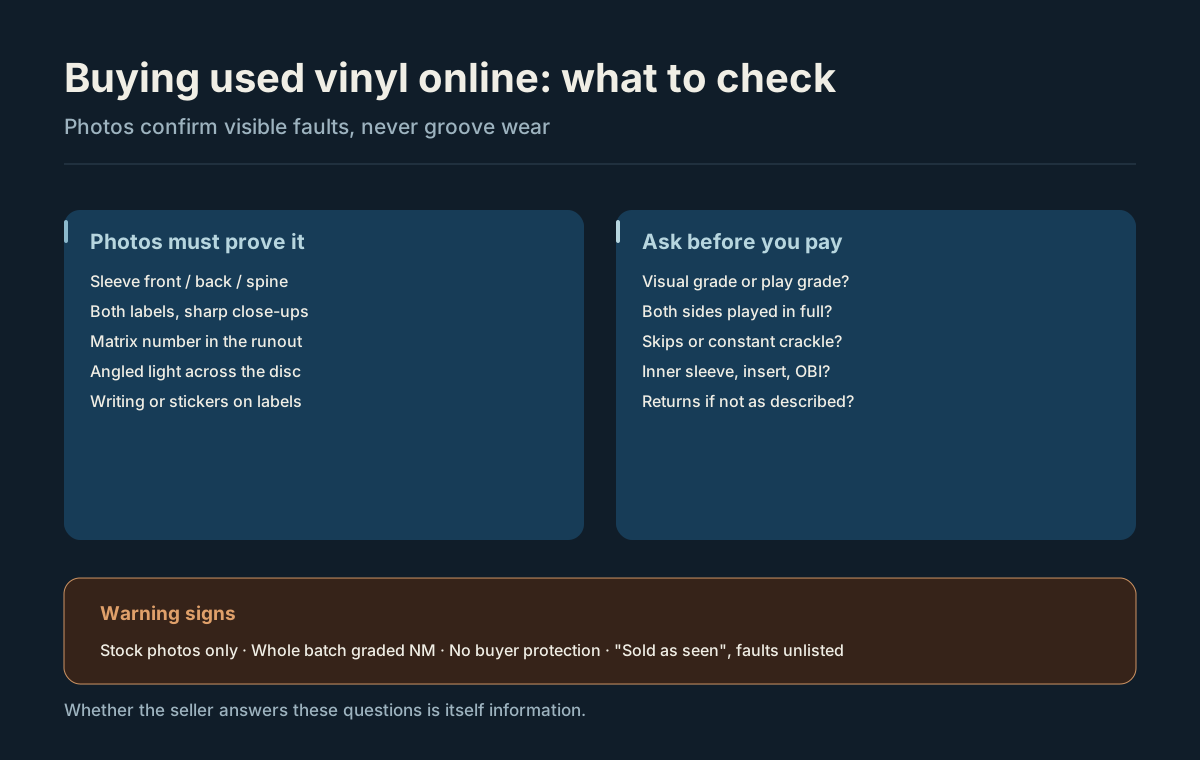
Illustration: Photos can confirm visible issues, but cannot confirm groove wear.
Quick Overview
- The core risk of online transactions is that the description doesn't match the actual item, not that you can't find a bargain.
- First check whether the photos are sufficient: front and back of the sleeve, spine, both labels, and a close-up of the matrix number. Missing items mean information gaps.
- Always confirm the field order for grading, and figure out which letter refers to the record and which to the sleeve.
- Ask verifiable questions: are there skips, where are the pops concentrated, are all extras included.
- An abnormally low price isn't a problem by itself; a low price plus an opaque description is the problem.
- Try to use payment methods with buyer protection, and complete the unboxing inspection within the platform's deadline.
Why Buying Used Records Online Is More Prone to Problems
In a physical store, you can take the record out and look at it under the light, or ask the owner to play it on the spot. Online transactions skip this step, replacing it with text and images. Information is always lost in transmission; the only question is how much.
The three most common types of loss are: first, photos only show the good side, with scratches and wear out of frame; second, grades are written higher than they should be, VG written as VG+, NM written as M, while each level in the grading system corresponds to specific wear descriptions; third, the seller themselves hasn't listened to it completely and can only fill it in by visual inspection—this isn't necessarily deception, but the result is the same.
Therefore, all actions before payment are essentially about compensating for these three types of loss. For the parts you can't fill in, use the transaction terms to cover them: whether returns are possible, how to return, whether the platform intervenes.
Step One: Judge Whether the Photos Are Enough to Support the Description
A trustworthy set of photos usually includes: front of the sleeve, back of the sleeve, spine, both labels, and a close-up of the matrix number. Some sellers also add shots of groove reflections, corner wear, and extras.
If there's only one front photo, it usually means the seller hasn't checked carefully, or doesn't intend to provide more information—before ordering, treat it as an information gap. Neither situation is suitable for ordering directly. You can directly ask for additional photos and see how they respond: a seller willing to take detail shots is usually also willing to tell the truth in the description.
When asking for additional photos, specify exact locations rather than vaguely saying "take a few more." A request like "Could you photograph the A-side label and matrix number, and the bottom right corner of the sleeve?" is more likely to get useful photos than "Can you take more?" If the seller repeatedly makes excuses or only sends the same image again, that's a clear signal.
Parts to Focus on in Photos
Looking at photos isn't browsing, it's checking item by item. These spots are most worth zooming in on:
- Four corners and spine of the sleeve: seam splits, bent corners, delamination, fading—these are the main reasons for downgrading a sleeve.
- Ring wear on the sleeve surface: usually caused by long-term friction from the record edge, and directly affects sleeve grading.
- Labels: any writing, stickers, tear marks, water stains—these affect the record's grade and identification.
- Surface reflections: scratches, cloudiness, whitened grooves visible under strong light are all signals that need follow-up questions.
- Matrix number: a readable matrix number both confirms the version and shows the seller actually took the record out to inspect it.
- Original inner sleeve and extras: inserts, posters, and obi strips peeking out in photo corners are all completeness information.
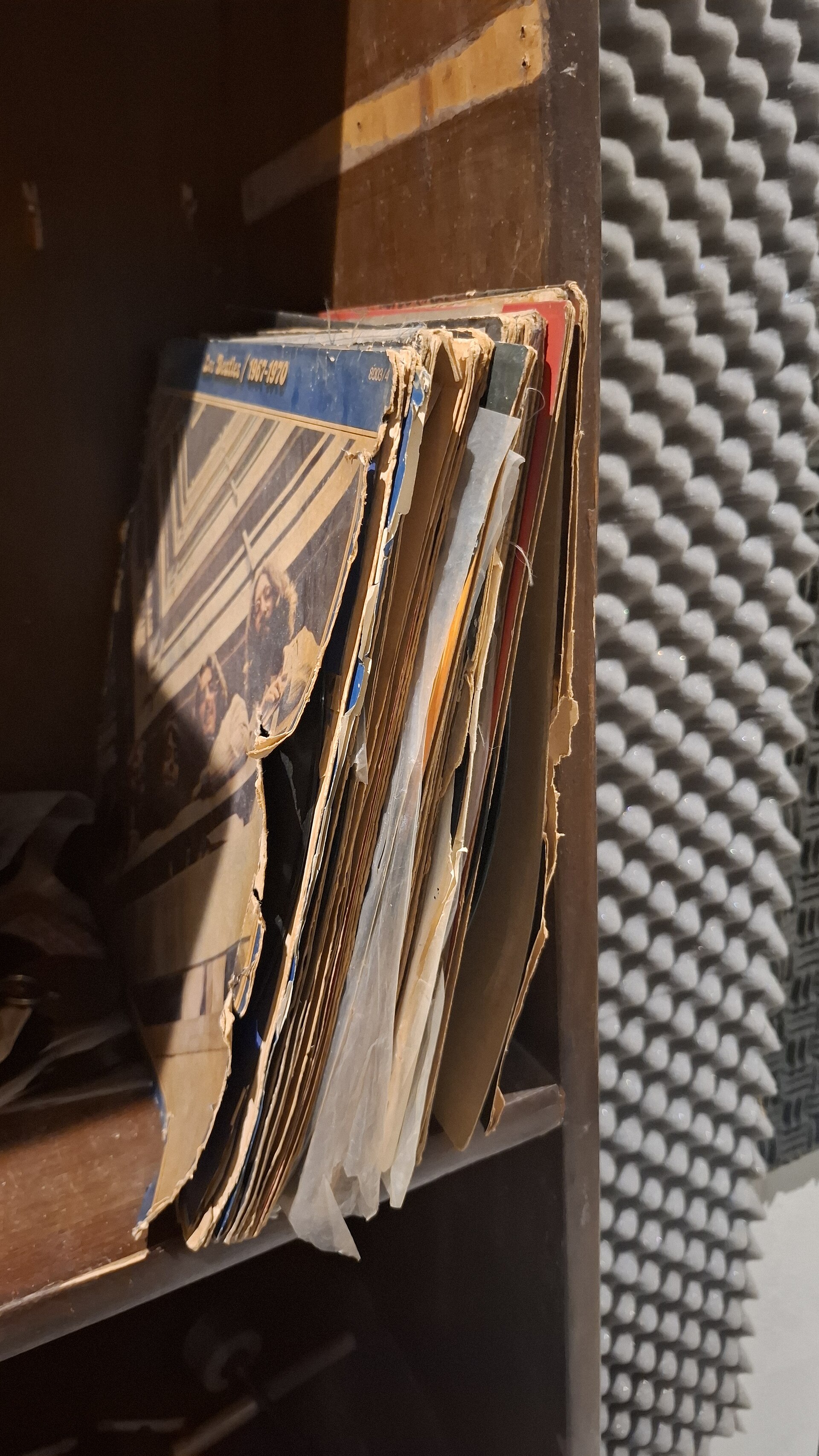
Seam splits, bent corners, and ring wear on the sleeve are the easiest to see in photos and the most important to verify.
Remember the limits of photos: they can confirm physical damage to the sleeve, marks on the label, and visible scratches on the record surface, but they cannot confirm wear inside the grooves. Noises that only appear during playback must be judged indirectly through questions and listening descriptions.
Reading Grades: Field Order and the Goldmine System
When a listing says VG+ / VG, the first thing is to confirm whether this is "record / sleeve" or "sleeve / record." Discogs fields usually put Media (record) first and Sleeve second, but private sellers aren't consistent. Reading the field order backwards will completely misalign your expectations.
If you're not familiar with these letters, read the Vinyl Condition Grading Guide first. Remember two key points: Good does not mean "good," but it doesn't mean "bad" either—a G-grade record can still play through without skipping, just with noticeable noise; VG means "there is audible wear," not "very good." These two are the most common sources of misinterpretation for beginners.
In the Goldmine system, each grade corresponds to a different degree of wear: M usually means sealed or near-new, NM allows extremely minor traces, VG+ can have light surface marks but very little playback impact, and VG clearly means there will be audible noise during playback. The original wording of this standard is worth reading alongside it, because in Chinese-language contexts these letters are often paraphrased inaccurately. Once you understand the descriptions, you can judge whether a price is consistent with the grade—if a VG record is priced like an NM copy, the more likely explanation is that the seller has overestimated the condition.
One more thing to note: scratches in photos and noise during playback do not correspond one-to-one. A clearly visible light scratch may not affect playback at all, while an inconspicuous groove wear mark may cause continuous crackle. Grading is only a way to compress information; it cannot replace listening.
Version Verification: Which Pressing Is Listed on the Product Page
In online transactions, version mismatches are as common as condition mismatches, and they are harder to remedy afterward. The same album may have multiple listings on sale at the same time, with prices ranging from low to high. If you order based only on the album title and cover, it's easy to buy a different pressing than you expected.
When verifying, focus on these items:
- Whether the catalog number matches the product page
- Whether the country and year of release match your expectations
- Whether the label design matches—the same album may use completely different labels in different countries
- Whether the deadwax code photo is clear and readable
- Whether the version identifier on the product page actually points to the batch you want
The deadwax code is the hardest evidence here. The distinction between etched and stamped, the mastering engineer's initials, and the pressing plant's mark can all quickly narrow things down. If the product page doesn't have a deadwax code photo, you can ask for one; sellers who are willing to cooperate usually will.
Another easily overlooked point: some sellers put "first pressing" in the title as a selling point, but it actually refers to the first release in their own country, not the first pressing in the country of origin. These two claims do not carry the same weight in the collector market. Before ordering, clarify exactly which pressing "first pressing" refers to—it's less trouble than arguing afterward.
Questions You Must Ask Before Paying
The more specific your questions, the more useful the seller's answers will be. You can confirm the following points one by one:
- Was this grade assigned by visual inspection, or after a full listen?
- Did you play both sides completely, or only listen to excerpts?
- Are there any skips, repeating crackle, distortion, or sections with particularly noticeable noise?
- Are there any signs of warping, edge lift, or whitish grooves?
- What accessories are included? Are the original inner sleeve, insert, poster, and obi strip all present?
- If it doesn't match the description upon arrival, how are returns handled, and who pays the shipping?
Whether a seller is willing to answer these questions is itself information. Sellers who are vague and only reply with "Don't worry, it's fine" usually carry higher risk; conversely, a seller who proactively says "There's a bit of surface noise on the last track of side B" is often more reliable than one who just writes "NM," because he is giving you information rather than a conclusion.
What Photos Can't Show: Groove Wear and Listening
Groove wear is the hardest thing to judge in online transactions because it almost never shows up in photos. It comes from the previous owner's stylus, tracking force, and equipment condition, and it shows up as continuous surface noise, occasional crackle, or distortion during more dynamic passages.
If the seller says they listened to it, you can follow up by asking about the equipment and conditions: what stylus was used, and whether the record had been cleaned. This information doesn't prove anything, but it can turn an answer from "I listened, it's fine" into a verifiable description.
If the record hasn't been cleaned, some of the noise may come from dust rather than wear, and there's a chance it will improve after you receive it; if the seller describes "whitish grooves, hazy appearance," it's more likely irreversible wear, or haze on the record surface caused by long-term contact with a PVC inner sleeve. Either way, price it according to the worst-case expectation first, then consider whether it's worth buying.
Also, when buying secondhand records, pay attention to speed and record type. 78 rpm records are mostly made of shellac, have wider grooves, and require a coarse stylus of about 3 mil, while the stylus tip used for LPs is about 0.7 mil; using the wrong stylus will not only fail to produce normal sound but will also accelerate damage to the record. If the seller also sells records in multiple formats, you can casually confirm whether he understands these differences.
Signals That Mean You Should Walk Away
Some situations don't require further hesitation—skipping them saves more time than continuing to negotiate:
- Only rendered images or online images are posted, with no actual photos of the item.
- An entire batch is graded NM, including obviously old records.
- The price is far below market, and the seller refuses to provide additional photos.
- The seller refuses a payment method with buyer protection and asks for a private transfer.
- The description says "no returns after sale" but does not explain where the specific problem is.
- Answers about condition issues are contradictory, or simply not answered.
A low price itself is not a problem. Clearing inventory, selling as a bundle, or a seller who doesn't know the market can all lead to low prices. A low price combined with an opaque description is the problem, because at that point you bear all the information risk without any corresponding room to negotiate.

When you can't see the item in person, the grade and photos are all you have to go on, so your questions need to be specific.
Payment Methods and Buyer Protection
Try to use a payment method built into the platform or one that offers buyer protection, and keep communication within the platform. Transferring money privately or moving communication off-platform means giving up all dispute resolution channels.
Before ordering, it's worth spending a minute to confirm a few things: the platform's definition of "not as described," how long the return window is, who covers return shipping, and whether the seller accepts returns. These terms are usually written on the platform's rules page, and it'll be too late to look for them once a problem arises.
Keeping evidence is also part of the process: save screenshots of the listing page, chat records, and photos provided by the seller. If you need to file a claim later, these are your only basis. When communicating, try to use text rather than voice, as text records can be quoted in full.
Inspection Process After Receiving the Item
Don't rush to put it on the turntable when unpacking. Checking in the following order will help you spot problems fastest:
- Check item by item against the description, especially the sleeve corners and the record surface.
- Under strong light, check the grooves for new scratches or cloudiness.
- Confirm whether all accessories are present and consistent with the seller's description.
- If conditions allow, play both sides completely, focusing on the passages mentioned in the description.
- Confirm version information, whether the inner ring code and catalog number match the listing page.
If you find a discrepancy, initiate communication within the platform's specified time limit as soon as possible, and keep unboxing photos. If you bought a counterfeit or imitation, you can double-check using the methods in How to Identify Counterfeit Vinyl Records. If the record has special accessories such as an obi strip or promotional markings, understanding its origin also helps judge its value; How to Identify Japanese Promo Records can serve as a reference.
Frequently Asked Questions
The seller wrote NM, but it arrived with obvious scratches. Is that not as described?
It depends on whether the scratches affect playback and whether they are visible in the photos. NM usually allows extremely minor marks, but obvious scratches and persistent noise constitute a grading discrepancy. In this case, you should first save evidence, raise the issue within the platform's time limit, and request renegotiation based on actual condition or a return.
What if I'm not sure which letter in the grade corresponds to which part?
Ask the seller directly to confirm which letter corresponds to the record and which to the sleeve, and ask them to fill in the fields completely in the description. Discogs typically lists the record first and the sleeve second, but there is no uniform standard for private transactions. Reading the fields backwards will directly affect your bidding judgment.
Are playtest descriptions reliable?
They can serve as a reference, but not as a guarantee. The seller's playback equipment, stylus condition, and cleaning habits can all affect the results. A more reliable approach is to consider the playtest description alongside other signals: the quality of the photos, whether they are willing to take additional photos, and whether their answers to specific questions are consistent.
If the price is significantly below market, does that definitely mean there's a problem?
Not necessarily. Clearance sales, bulk sales, or a seller unfamiliar with the market can all result in low prices. What you need to be wary of is when a low price coincides with a lack of transparency, such as refusing to take additional photos, refusing to describe condition details, or requesting private transfers. When these situations stack up, the risk clearly outweighs the reward.
Should I clean the record first after receiving it?
It's advisable to inspect before cleaning. Cleaning can remove some noise caused by dust, but if the problem is groove wear, cleaning won't improve it. For shellac records and PVC records, the cleaning methods also differ. Before you start, confirm the material to avoid causing irreversible damage by using the wrong method.
Buying used records is essentially a business of information. What you're buying isn't just the record itself, but also how much the seller is willing to tell you, and how much you're willing to pay for that.
Image Credits
The photos in this article are taken from Wikimedia Commons and used under the licenses indicated for each image; the illustrative annotations were created by GROVV.
- Seam splits, bent corners, and ring wear on the sleeve are the easiest things to see in photos and the parts you should check most carefully: Leoconbass · CC0 · Source
- When you can't see the item in person, the grade and photos are all you have to go on, so your questions need to be specific: Seth Doyle sethdoylee · CC0 · Source

