Old records that are inherited, dug out of attics, or left in basements for years almost never have just one problem. Dust is only the outermost layer; beneath it are mold spots, smoke smell, water stains, warping, and paper sleeves that have become brittle and acidic. Whether they can be saved is often mostly determined before you even start—identifying the type of damage first and then deciding how much effort to invest is far more effective than immediately scrubbing hard.
This guide gives an order from assessment to treatment: first distinguish the types of grime, then handle them step by step from low to high risk, and finally clarify which damage cleaning can improve and which it cannot. The goal of cleaning is not to make the record look new, but to remove the reversible part without causing new damage.
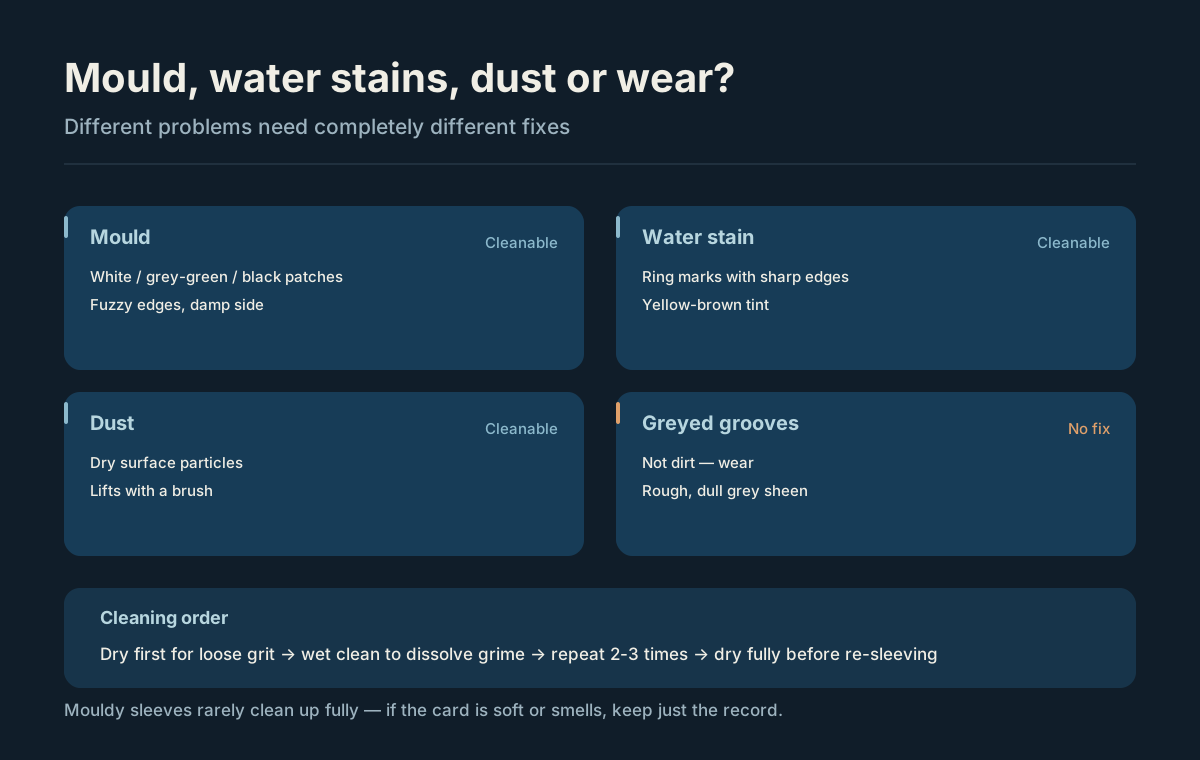
Illustration: The first three types of cleaning can improve; whitened grooves cannot be repaired.
Key Points at a Glance
- Classify before cleaning. Mold spots, water stains, dust, and whitened grooves are four different problems, and only the first three can be improved by cleaning.
- Dry treatment always comes before wet treatment. If loose particles are rubbed repeatedly in a dry state, they will be pressed into the grooves.
- Old records usually need two to three rounds of wet cleaning before showing noticeable improvement; it is rare for one round to be enough.
- Mold is not just an appearance issue, but also a health issue. Wear an N95-level mask and disposable gloves when handling, and work in a ventilated area throughout.
- Judge sleeves and records separately. Moldy sleeves can be replaced, and the structural integrity of the record itself is more worth preserving.
- Whitened grooves, deep scratches, and severe warping are irreversible damage. If these appear, continuing to clean only increases risk.
First, Isolate Safely
Do not put moldy records directly on the turntable, and do not store them in the same row as clean collectibles. Mold spores spread through air and contact; once they land on other sleeves, they will grow again under suitable conditions. Isolation is not overkill: if a batch of damp records is mixed with a collection, under suitable conditions it may affect the entire row.
The specific steps are:
- Place records to be treated separately in a ventilated, dry, dark place, and do not put them in an airtight box.
- Prepare disposable gloves and an N95-level mask. When stirring dried mold spots, spores are most likely to become airborne, and inhaling them may cause allergic reactions.
- If the inner wall of the sleeve has already grown mold, remove the record first, and let the sleeve and record be treated separately to avoid cross-contamination.
- After handling, clean the work surface and the tools used to avoid residual spores contaminating the next batch of records.
Distinguish Mold Spots from Ordinary Dirt
If you misjudge the type, all the following methods will be wrong. Using a strong cleaner on a record surface that is only dusty amounts to adding an unnecessary risk; using a dry brush on a problem that has already penetrated the material has no effect at all.
- Mold spots: usually white, gray-green, or black spots, sometimes with fluffy edges, concentrated on damp contact surfaces, such as where the inner wall of the sleeve touches the record surface.
- Water stains: ring-shaped marks with clear edges, yellowish-brown in color, mostly from past dampness or natural drying after soaking.
- Dust: dry surface particles that can be removed with a brush and do not feel sticky to the touch.
- Whitened grooves: areas on the record surface that appear gray and have lost their luster, looking as if covered with a layer of powder. This is not dirt, but a manifestation of worn grooves, and no cleaning can restore it.
There is also a type easily misjudged: old cleaner residue or inner-sleeve leachate on the record surface. These often appear as a uniform haze rather than spots, and are handled completely differently from mold spots. If you cannot tell, first test a small amount of cleaning solution on an inconspicuous spot and observe whether there is improvement before deciding whether to treat the whole record.
Only by distinguishing these types can you avoid using the wrong method on a record that was originally just a little dirty.
Dry Treatment: First Get the Loose Particles Out
The purpose of dry treatment is to remove loose particles from the surface, not to wipe away grime. If this step is not done thoroughly, during wet treatment the particles will be dragged back and forth in the liquid, which is like sliding abrasive paste across the record surface.
- In a ventilated area, use a carbon fiber brush or soft-bristle brush, gently passing along the groove direction without pressing hard.
- The brush will accumulate dust; after a few strokes, tap or wipe it clean on the side to avoid spreading the dust back onto the record surface.
- If there are obvious fluffy mold spots on the record surface, first use a dry soft cloth to gently cover and absorb them; do not rub hard directly in a dry state.
- For old records, after dry brushing, you can treat the surface once more with a dust roller or microfiber cloth to remove remaining short fibers.
This step can only address the surface layer. It is normal to see the record surface still gray and dull; the following wet treatment is the main process.
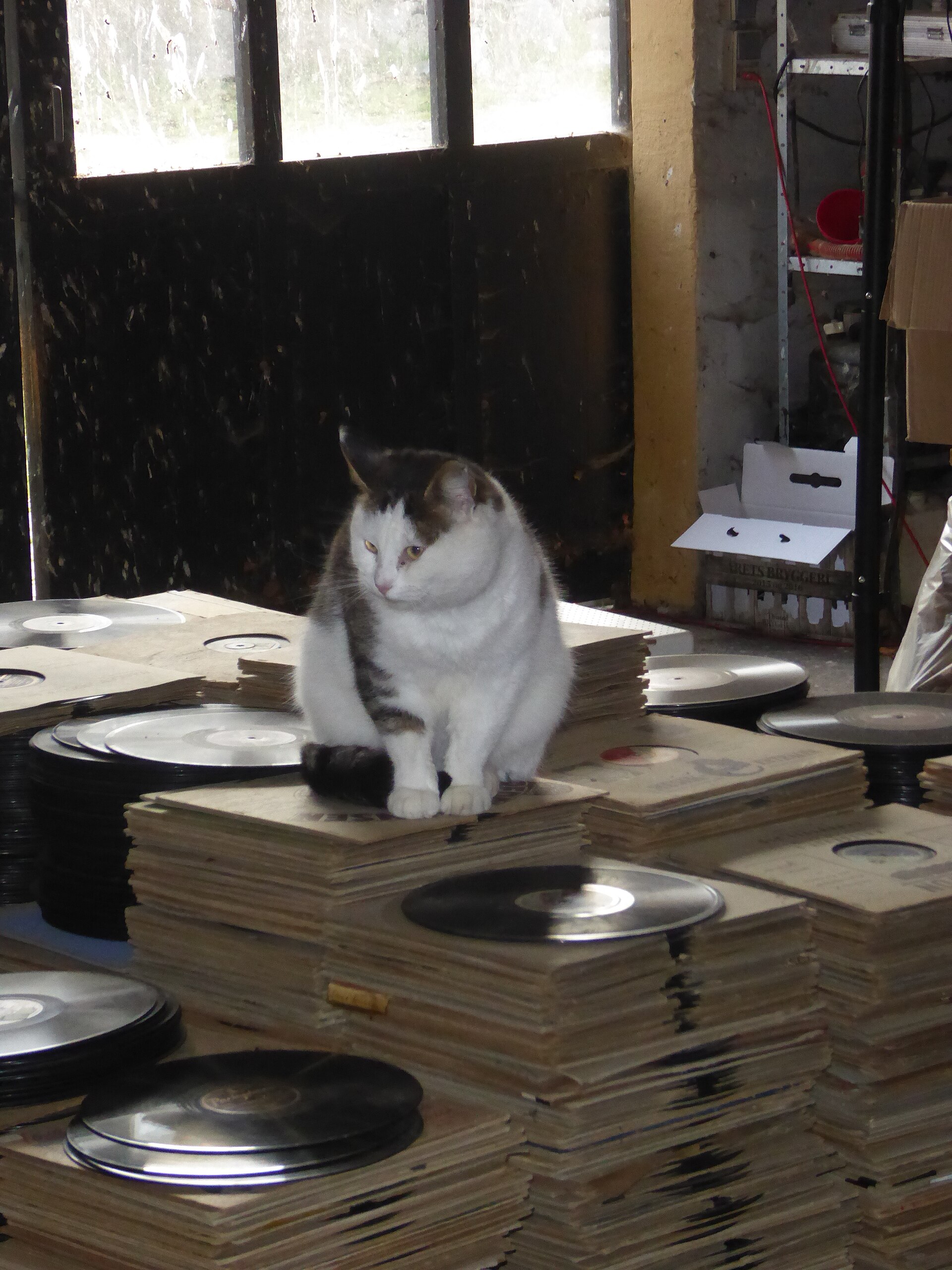
Stored long-term in a humid environment with large temperature differences, mold spots and warping almost appear at the same time.
Wet Treatment: Let the Dirt Enter the Liquid
The core logic of wet treatment is simple: let dirt and mold residue remain in the liquid, then leave the record surface together with the liquid. So the key is enough liquid, gentle motion, and thorough rinsing at the end.
- Use a mild cleaning solution to thoroughly wet the record surface, letting the liquid stay in the grooves for a moment to soften the dirt.
- Use a dedicated record brush or microfiber cloth, working in sections along the groove direction, turning to a clean side for each section.
- Do not scrub in circles with force on the record surface. Scratches in the circumferential direction cross multiple grooves and are the hardest type of damage to remedy.
- For stubborn areas, repeat wetting and gentle passes rather than increasing force. Stronger cleaner is not necessarily better.
The principle for choosing a cleaning solution is neutral, residue-free, and non-abrasive. Alcohol-based formulas are not friendly to some old materials, so it is best to confirm the scope of application before use. Shellac 78s are especially sensitive; their water resistance is far inferior to later vinyl. For related properties, see the explanation of Shellac.
If after one round of washing the rinsed-off water is still cloudy, it means there is still residue and another round is needed. For old records, two to three rounds is normal; there is no need to increase intensity just because one wash did not get them clean.
How to Choose Between Manual Cleaning and a Record Cleaning Machine
Both methods work; the difference lies in controllability and consistency.
- Manual cleaning: low cost and the finest control over a single record, suitable for cases with concentrated mold spots and special conditions. The downside is that the technique and amount of water used per record are not easy to keep consistent.
- Record cleaning machine: through vacuum suction or clamping, it lets the record surface contact the cleaning solution evenly and sucks away dirty water. Consistency is better, making it suitable for batch processing. When using it, pay attention to cleaning the suction nozzle and brush strips; a dirty nozzle will carry contaminants to the next record.
- Ultrasonic equipment: has a clear effect on loose dirt deep in the grooves, but it also requires a suitable cleaning solution and thorough rinsing afterward; the drying step cannot be omitted.
No matter which method is used, the criteria for judging are the same: whether the water is clear after rinsing, whether the record surface still feels slippery, and whether there are new residue marks after drying. Do not expect to get old records done in one pass; dividing it into two or three rounds with thorough rinsing each time is much safer than increasing cleaning intensity all at once.
Rinsing and Drying
Rinsing is often omitted, but it is the step that determines whether "washing makes it cleaner." If cleaning solution remains in the grooves, it will form new residue after drying, and the sound may be worse than before washing.
- Rinse thoroughly with clean water until the record surface no longer feels slippery and water spreads evenly on the surface instead of forming beads.
- After rinsing, do not wipe with an ordinary towel; fibers will remain in the grooves and become a new source of contamination after drying.
- Stand it upright on absorbent paper or a lint-free cloth to dry naturally, or use a clean lint-free cloth to gently press and absorb water droplets; do not wipe back and forth.
- Make sure it is completely dry before putting it back into the inner sleeve. If moisture is sealed in the bag, it is equivalent to creating a stable growth environment for mold.
The drying environment should be away from light, ventilated, and free of obvious dust. Rushing to bag it is the most common mistake; waiting an extra half day is far more worthwhile than washing it again.
How to Deal with Musty and Smoke Smells
Odors come from the sleeve and residue on the record surface; masking them is useless.
- After cleaning, leave the record in a ventilated place for a few days to let volatile substances dissipate naturally.
- Do not use perfume, fragrance, or air fresheners. They will adhere to the record surface, be carried into the grooves by the stylus during playback, and may also leave oily residue.
- If the sleeve's odor has already penetrated the cardboard, it is basically impossible to remove completely; replacing it with a neutral sleeve is more practical.
- The record itself usually smells less than the sleeve; handling the two separately often brings obvious improvement.
If an entire batch of records smells of smoke, separating records from sleeves and ventilating them in batches is the most effective way; do not expect to clean it all in one go.
Material Differences in Old Records
Records from different eras and materials can withstand different cleaning intensities.
- Shellac 78s: the material is hard and brittle, more sensitive to water and alcohol than vinyl, and the grooves are wider, requiring playback with a coarse stylus of about 3 mil, while LPs usually use a stylus tip of about 0.7 mil. When cleaning, movements should be gentler, and prolonged soaking should be avoided.
- Early vinyl LPs: relatively tolerant, but still afraid of high temperatures and abrasion, and will still deform under long-term pressure.
- Thin records and thinly pressed reissues: insufficient rigidity, more prone to deformation from stress during cleaning and handling.
In addition, before 1954, the equalization curves of different labels were not unified; the RIAA equalization standard was only gradually unified into a single curve later. This fact affects the equalization settings during playback, not the cleaning method, but understanding it can help you judge whether an old record "sounds muffled" because of a cleaning problem or a setup problem; see RIAA equalization.
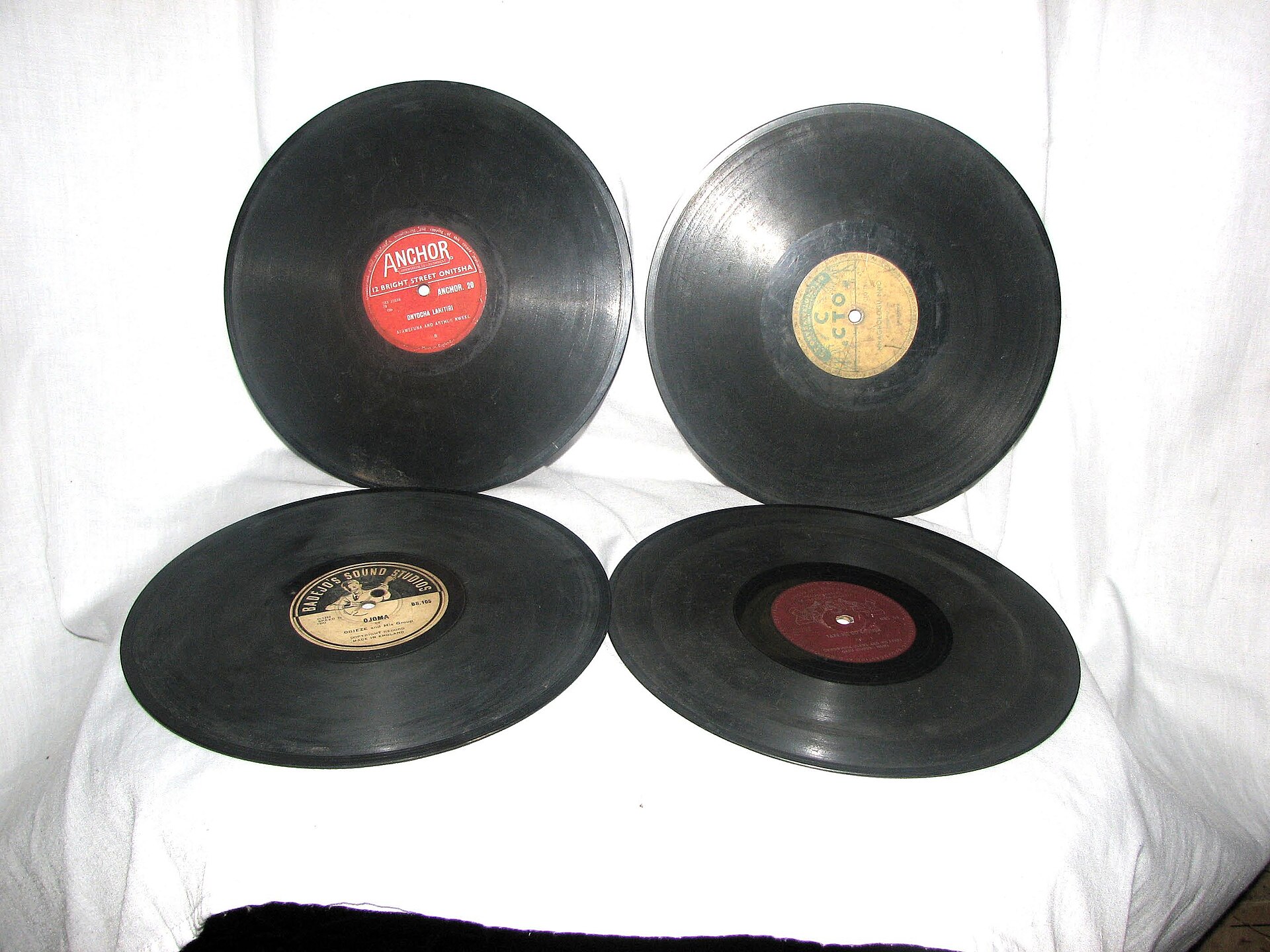
Damage to old records often stacks up: dust, mold spots, wear, and sleeve aging.
What to Do About Sleeves
Once the paper material of a sleeve grows mold, it is very difficult to remove completely. Mold will enter the cardboard fibers; surface wiping can only remove the visible part.
- Use a dry soft cloth to wipe off surface mold spots, and air-dry in a ventilated place; do not expose to direct sunlight, as it will further deform and embrittle the cardboard.
- If mold spots have already penetrated the cardboard, the sleeve has become soft, or there is an obvious odor, consider keeping only the record and replacing it with a neutral inner sleeve and outer sleeve.
- Original sleeves may have collectible value even if flawed. First determine their version significance, then decide whether to discard them.
- When replacing sleeves, keep the original inner sleeves and accessories. Labels, inserts, and posters are often harder to find than sleeves; once lost, they cannot be replaced.
To judge whether an original sleeve has value, look at version information. The ideas about matrix / runout codes and printing details mentioned in Identifying Counterfeit Records also apply to confirming whether an old sleeve is original. Once the collection grows, managing your collection with GROVV can record information such as "which one had its sleeve replaced, which one is original," so that years later you will not be unable to tell yourself.
When to Stop
Cleaning has diminishing returns. Beyond a certain point, the time invested and the risk both rise, while the sound will not get better.
If the following situations occur, it is recommended to stop:
- The grooves have turned white or gray, feel rough, and show no proper reflection when held up to the light.
- There are obvious deep scratches on the surface, especially scratches running across the grooves.
- The record is already severely warped, with the edge clearly lifting or becoming wavy when laid flat.
- Mold stains have already eaten into the surface material, leaving matte patches that cannot be wiped away.
At this point, continued cleaning will not make the sound better; instead, it may amplify both reversible dirt and irreversible damage into new problems. The value of an old record sometimes lies in its very existence, not in whether it can play perfectly. This is also one of the reasons many people still choose to listen to secondhand vinyl: accepting the history it carries, rather than demanding that it be like new.
Frequently Asked Questions
Do moldy records absolutely have to be washed?
If there are only scattered mold spots on the outside of the sleeve and the record itself is clean, you can isolate it and observe first; there is no need to wet-clean immediately. But if mold stains are visible on the record surface, it is advisable to clean it before playing; otherwise, mold residue will remain on the stylus and be carried to the next record.
Can household cleaners be used?
Not recommended. Dish soap, glass cleaner, and alcohol-based disinfectants may all leave residue or damage the material, and formulations vary greatly between products, making it hard to judge which is safe. Use a dedicated record cleaning fluid, or only a confirmed neutral solution.
Will cleaning increase a record's value?
Cleaning can improve appearance and playback performance, but it will not reverse wear. Existing scratches and whitened grooves will not disappear with washing. In terms of condition grading, cleaning improves the "presentable state," not the condition grade itself.
How many washes are enough?
Judge by whether the rinse water is clear and whether the record surface still feels slippery, not by a fixed number of times. In common cases, old records need two to three rounds, while records in better condition need only one.
How long does drying take?
It depends on ambient humidity and ventilation. Usually, the standard is "the surface is completely free of moisture and feels cool to the touch." It is better to leave it longer than to put it into a sleeve before it is completely dry.
Conclusion
The process of dealing with old records is essentially an exercise in judgment: first see clearly what kind of problem it is, then choose the method with the lowest risk, and then make clear where to stop. Cleaning is only one part of it. What really determines how much longer these records can stay with you is how they are stored afterward, and whether you are willing to accept the parts of them that cannot be repaired.
Image Credits
Photos in this article are taken from Wikimedia Commons and used under the licenses marked for each image; diagrams are made by GROVV.
- Long-term storage in a humid environment with large temperature swings causes mold stains and warping to appear almost simultaneously: Nemo bis · CC BY-SA 3.0 · source
- Damage to old records often piles up together: dust, mold stains, wear, and sleeve aging: No machine-readable author provided. Domaleixo assumed (based on copyright claims). · CC BY-SA 3.0 · source

