Two records with nearly identical covers can differ in price by several times. Distinguishing them relies not on eyesight, but on two sets of numbers on the record itself: the catalog number printed on the sleeve and label, and the matrix / runout code etched in the innermost blank area. The former indicates "which release this is," while the latter indicates "which pressing batch this is."
Understanding the relationship between these two sets of numbers is the foundation for accurately identifying versions. The catalog number is a number the record company actively makes public; it's easy to see and easy to counterfeit. The matrix code is a trace left during production; it's inconspicuous yet harder to fake. Only by cross-checking the two can you even begin to judge the version, and only then can you talk about valuation.
This article will proceed in the order of "first read the catalog number, then read the matrix code, and finally match the two together," interspersed with common readings and pitfalls. No professional equipment is needed throughout—a flashlight and a phone capable of close-up shots are enough.
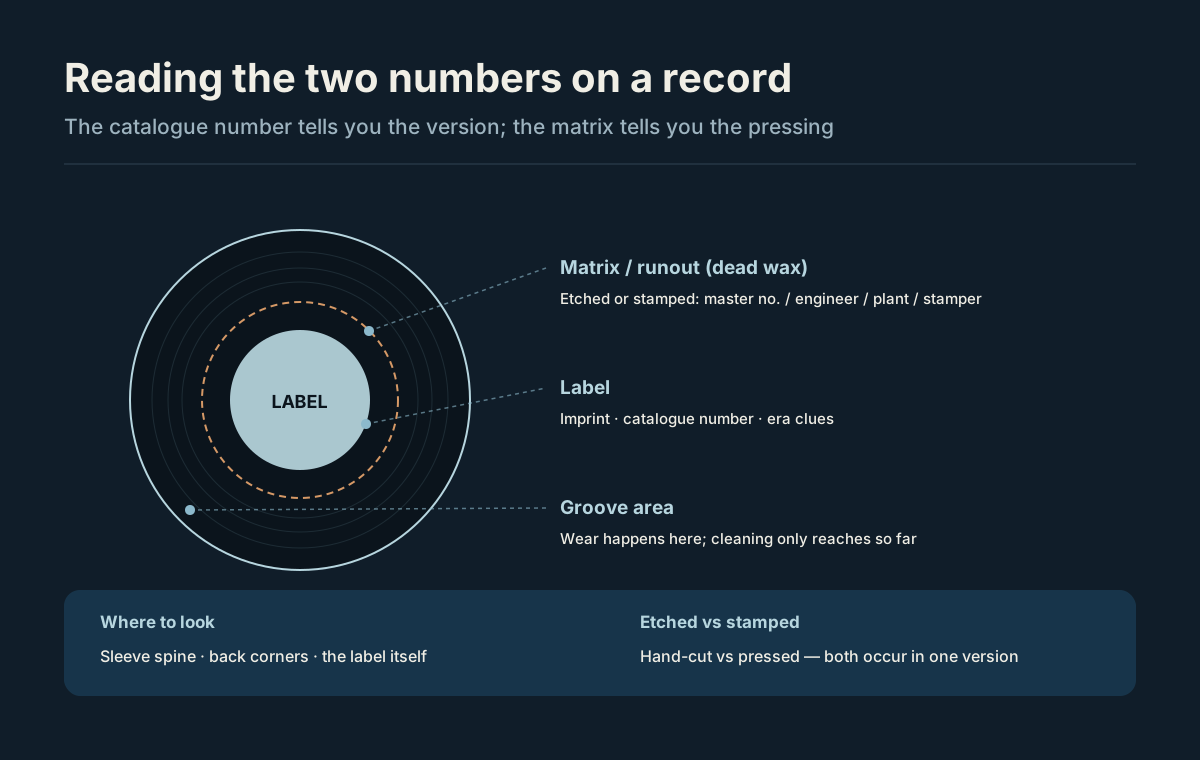
Diagram: The catalog number defines the release, the matrix code defines the pressing.
Quick Overview
- The catalog number is the number a record company assigns to a release, usually appearing simultaneously on the spine, back cover, and label.
- The matrix code is located in the blank area between the end of the grooves and the label (often called the dead wax), and includes the master number, cutting marks, pressing plant code, and stamper number.
- Etching and stamping are two different things: the former is hand-etched by the cutting engineer, the latter comes from the metal stamper; confusing the two will directly lead to misjudgment.
- Judging the version solely by the cover or copyright year is the most common mistake; reissues often deliberately replicate the appearance of the first pressing.
- The catalog number narrows the range, the matrix code confirms uniqueness; both must be looked at together.
- The information read must be recorded immediately, otherwise the next time you encounter the same item you'll still have no basis for comparison.
What a Catalog Number Looks Like
The catalog number is an internal number used by the record company; its format is decided by the company itself, so there are no unified rules. But broken down, it usually consists of three parts:
- Prefix. Letters or a combination of letters, possibly indicating a series, price tier, release type, or label branch.
- Main number. The core part of the number, usually sequential within the same series.
- Suffix. Used to distinguish country, region, packaging format, or reissue batch, or may just be letters.
It generally appears in three places: the sleeve spine, the back cover corner, and the label. In principle, the numbers in all three places should match; when they don't, that in itself warrants further verification.
The greatest value of the catalog number is searchability. Album names are vague; the same name can correspond to many versions. The catalog number is precise; entering it into Discogs' search box usually quickly narrows it down to a specific entry. On a Discogs release page, the catalog number and matrix code are listed in two separate fields: the former is Catalog Number, the latter is Matrix / Runout. Both fields are filled in when information is available; not every record has them complete.
There are a few practical habits when using them:
- Transcribe completely, including spaces and hyphens. Different formats may point to different entries.
- Watch out for letter O vs. number 0, and letter I vs. number 1. When the font is similar, cross-verify using other information in the entry.
- Don't rely solely on the number on the cover. Some versions have outer sleeves that don't match the inner record, especially common in secondhand channels.
The Label Is Also a Version Clue
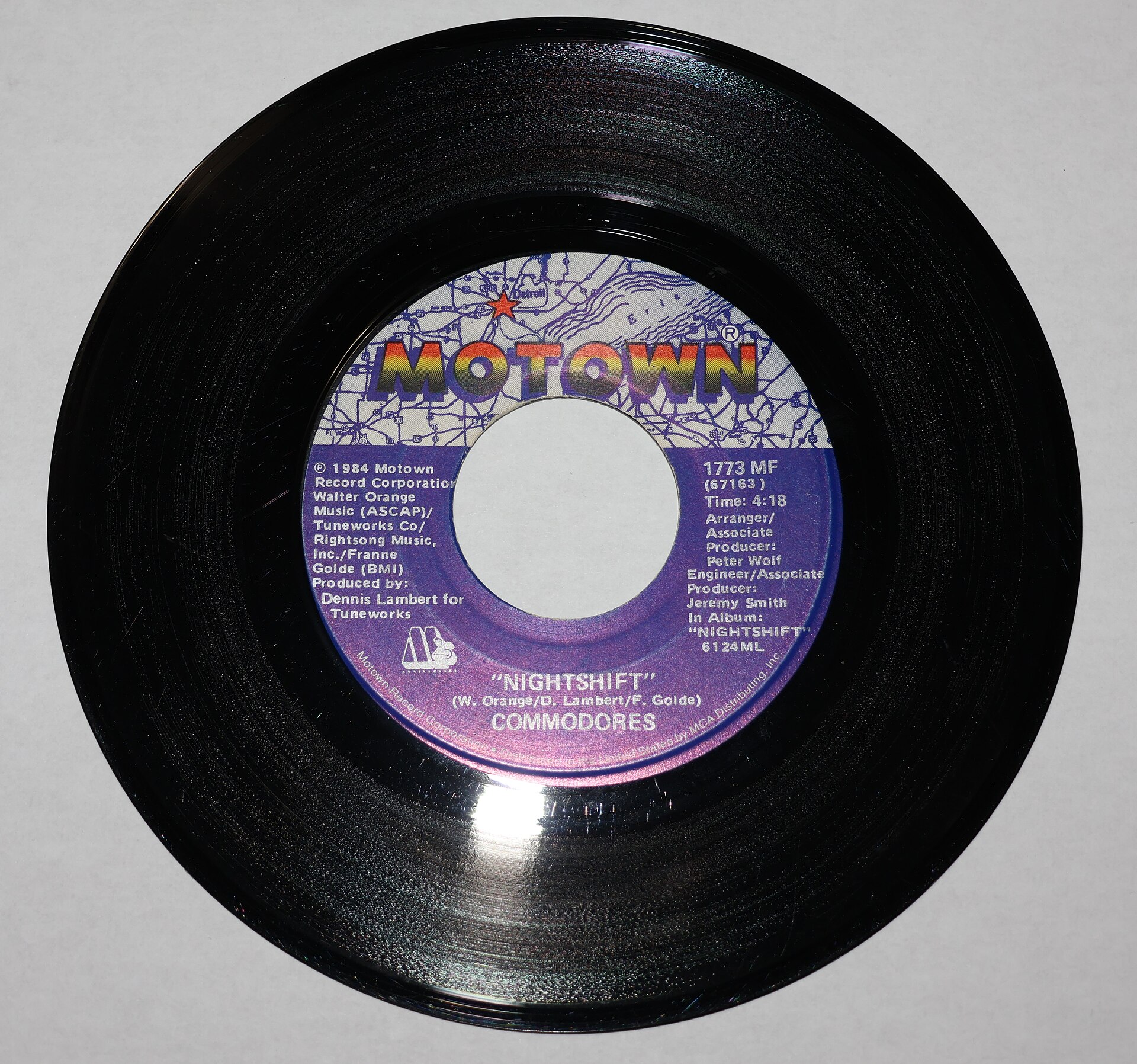
The catalog number on the label is the most direct keyword for locating a version.
The label is the circular tag affixed to the center of the record; it serves two functions at once: printing the catalog number and exposing version clues. For 7-inch singles, the label is often the only place to quickly distinguish different pressings: singles often come in plain company sleeves with almost no cover information.
Changes worth noting include:
- Layout and font. The same label may change its layout in different periods; changes in font details often correspond to production stages.
- Color and background. Promotional copies and radio copies often use different background colors or label styles from regular releases.
- Text content. Changes in the wording of label addresses, copyright lines, and release years can all be time clues.
- Center hole. The difference between a large hole and a standard hole is usually related to jukebox use or regional habits.
None of these clues alone are accurate enough; only when combined with the matrix code can the version be confirmed.
Where to Find Information on Early Records
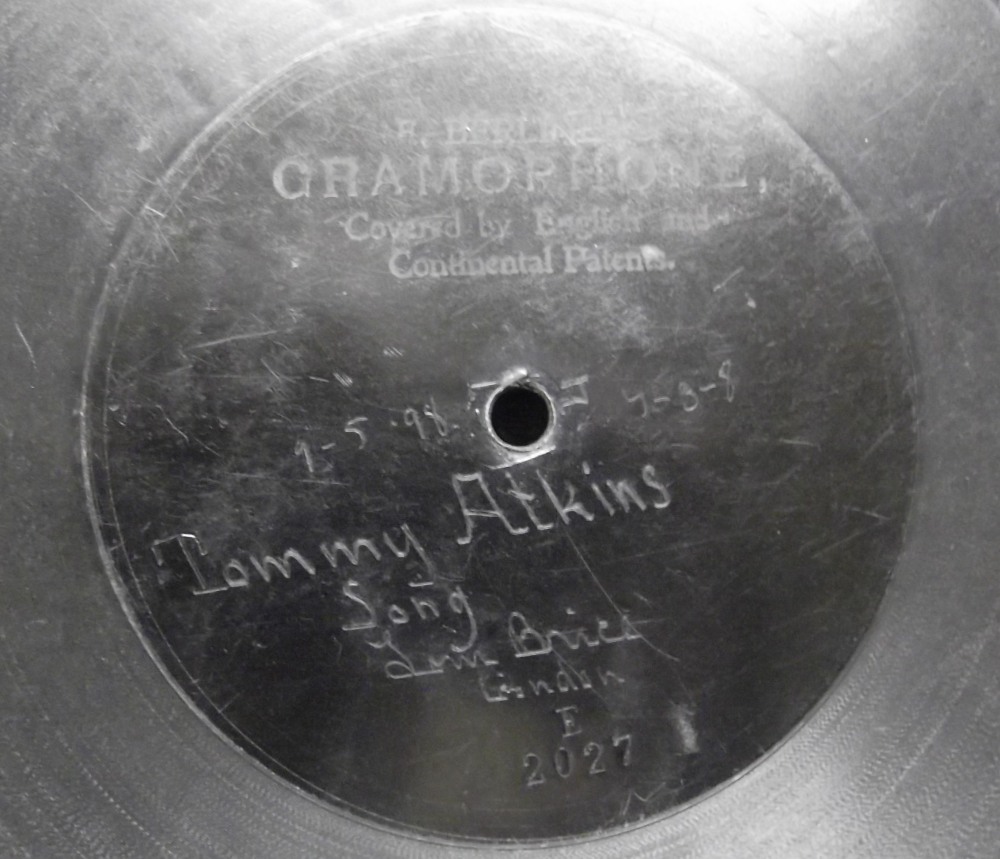
1898 records had no printed labels; information in the label area was recorded by handwriting and etching.
Before printed labels became widespread, identifying information on records relied mainly on handwritten labels and etchings. This also explains why research methods for early records differ from those for later vinyl: the earlier the era, the more it relies on content etched directly onto the disc. Understanding this period of history is not for antiquarianism, but to establish a concept—information on a record has never been just one layer: printed, etched, and stamped each correspond to different steps in the production process.
The same judgment logic needs adjustment when applied to 78 rpm records. Most 78s are made of shellac, have wider grooves, and require a coarse stylus of about 3 mil, whereas LPs typically use a stylus tip of about 0.7 mil; the material is more brittle and more sensitive to alkaline cleaners, so playback and cleaning methods must be changed accordingly. The process has changed, but the order of identification remains the same: first look at printed information, then look at etched information.
There is also a time-related variable: the RIAA equalization curve was not standardized before 1954, and different labels had their own schemes. It does not directly determine the edition, but it can make the same old record sound different under different settings.
Where the Matrix Code Is Located
Turn the record to the side with the label and look outward from the edge of the label. After the outermost music grooves end, there is a blank area with no music between them and the label; this ring is the run-out area, often called the "dead wax" or run-out area in collector circles. The matrix code is etched here, sometimes near the label, sometimes near the end of the grooves; its position is not fixed.
The method of observation is straightforward:
- Place the record on a stable surface and shine a side light or flashlight obliquely across the run-out area.
- Adjust the angle until the etchings cast shadows, making the characters easier to recognize.
- Take a close-up photo with your phone and zoom in to read character by character; this is more reliable than repeatedly identifying with the naked eye.
- Write down the complete content, including slashes, hyphens, and spaces.
Some matrix codes are etched very faintly or are interfered with by the label edge or pressing marks. In this case, changing the direction of the light source and trying a different angle is usually more effective than simply increasing brightness.
What Can Be Read from the Matrix Code
The matrix code is not a string of random characters; it corresponds to specific steps in the production process. Common contents include:
- Master number or release number. Related to but usually different from the catalog number; it is the number used when cutting the lacquer.
- Signature or initials of the cutting engineer. The habit of cutting engineers leaving marks on the lacquer has made certain initials recognizable markers in collector circles.
- Stamp of the cutting room or mastering facility. Indicates where the record was cut.
- Pressing plant code. Indicates which factory pressed the record; the same release produced at different factories will differ.
- Stamper number. Indicates which batch was pressed from the same set of metal stampers.
- Other markings. For example, mono/stereo distinction or production batch information.
Only by combining this information can one answer "which edition, which factory, which batch."
How to Distinguish Etching from Stamping
This is the most important set of concepts in this article, and also the most easily confused.
- Etched: The cutting engineer hand-engraved on the lacquer, which was transferred to the record via the metal stamper. The strokes have a handwritten feel, the size and spacing are not perfectly uniform, and sometimes it is a cursive abbreviation.
- Stamped: A machine impression from the metal stamper, with regular font and consistent spacing, commonly seen in stamper numbers and factory codes.
In the run-out area of the same edition, both may exist simultaneously, or only one may be present. Mistaking stamped for etched can lead to wrong conclusions: you might mistake a reissue for an original, or vice versa. The method of distinction still comes back to form—handwritten feel versus machine font, whether the stroke depth is uniform, and whether there are natural irregularities between characters.
It should be emphasized that etching itself does not mean better. It only indicates that this piece of information comes from the cutting stage, not the copying stage. Value judgments should be made by considering the edition, pressing plant, cutting source, and actual condition together; drawing conclusions based on a single mark is unreliable. The judgment of bootlegs and counterfeits follows the same logic: they may replicate the cover and label, but it is difficult to replicate consistent run-out details. This point is expanded in more detail in the site's content on bootleg records.
Common Misconceptions
- Looking only at the cover. Reissues often deliberately replicate the original cover, and even the inner sleeve and label design.
- Looking only at the year. The copyright year belongs to the work, not to the year this record was pressed; the same copyright year can correspond to production spanning multiple years and factories.
- Recognizing only the words "first pressing." First pressings from different countries are different editions, with different pressing quality and market availability.
- Ignoring label design. Changes in label layout, color, and text are often the most direct clues for distinguishing editions.
- Treating the matrix code as decoration. Not understanding it does not mean it is unimportant; it is precisely the key to distinguishing different batches of the same edition.
In addition, there are records on the market specifically counterfeiting popular editions. When judging, you can use the site's approach to identifying counterfeits: print quality, paper feel, disc gloss, and label alignment are all evidence that corroborates the matrix code. No single feature is sufficient to draw a conclusion.
From Numbers to Edition: A Repeatable Process
Fix the above methods into an order, and any record can be handled by the same steps:
- Record the catalog number. Read it from the label and cross-check it against the spine and back cover for consistency.
- Read the matrix codes. Read both sides; Side A and Side B are often different.
- Distinguish between etched and stamped markings. Record them separately; don't mix them together.
- Search by catalog number. Find candidate entries on Discogs.
- Compare using matrix codes. Check each item in the entry's Matrix / Runout field, including the etching and factory codes.
- Verify label and sleeve characteristics. Layout, colors, text, and copyright lines serve as cross-validation.
- Record the condition. Once the version is determined, the condition determines the actual state of this copy; evaluate the two separately.
When valuing, the median price and sales history on Discogs can serve as references, but you need to understand what they mean: these numbers come from the platform's historical sales and listing statistics, with different criteria, and none of them equal "how much your copy can sell for." Before using them, first confirm how the platform defines them. The real judgment also requires combining condition, completeness, and market demand. For condition grading standards, there is a dedicated condition grading guide on the site; it's recommended to read them together.
A reminder here as well: version identification solves "what it is," not "how much it's worth." Only after clarifying the version does price have a basis for discussion; reversing the order makes it easy to pay unnecessary premiums for an ordinary reissue.
Only Useful If Written Down
After reading the catalog number and matrix codes, write them into your collection records. The reason is practical: this information cannot be maintained by memory alone, especially when your collection contains multiple versions of the same album; without records, you'll have to look it up again each time.
A useful record should at least include: catalog number, matrix codes (recorded per side), etched and stamped markings, pressing plant or mastering source, label characteristics, and condition. With these fields, the next time you encounter the same record, you can immediately tell whether it's a duplicate or a new version, and you can give an accurate description in transactions.
Using tools to manage these fields is far more reliable than scattered notes and screenshots. For specific methods, refer to the site's guide on managing your collection with GROVV.
Frequently Asked Questions
Does the same catalog number always mean the same version?
Not necessarily. The catalog number only corresponds to "which release"; the same release may be pressed at different plants at different times, resulting in different matrix codes. Determining uniqueness requires combining the matrix codes, label design, and sleeve details; only when all three match can it be considered the same version.
Should matrix codes be copied down completely?
As completely as possible. Slashes, hyphens, spaces, and character order can all be part of distinguishing entries. If a character is truly illegible, record it and note the uncertainty rather than omitting it, because omission will distort the comparison results.
Can the copyright year be used as the pressing year?
No. The copyright year corresponds to the year of the work or recording; a record may be pressed many years after that year. Determining the pressing time requires inference from the catalog numbering system, label changes, and matrix information together.
Why do two records of the same version have different matrix codes?
Because they may come from different metal molds or different pressing batches. Marks such as mold numbers are used to distinguish these batches, so differences within the same version are normal and do not mean one of them is defective.
Does hand etching mean better sound quality?
That doesn't follow. Etching only indicates that the information comes from the cutting stage; it doesn't mean higher cutting quality, nor does it mean a better master source. Sound quality depends on multiple stages including the master, cutting, pressing, and material, and ultimately comes down to the condition and playback state of this particular record.
Final Thoughts
The catalog number and matrix codes are the ID card the record carries itself. The former helps narrow it down to a single release, while the latter helps confirm which specific pressing batch it is. Reading both is not difficult; the hard part is developing the habit of recording them—the true value of collection management is not noting "what I have," but noting "what this specific copy of mine is."
Image Credits
The photos in this article are from Wikimedia Commons, used under the licenses indicated for each image; the diagrams are created by GROVV.
- Records from 1898 didn't have printed labels yet; information in the label area was recorded by hand and engraving: Oliver Mundy · CC BY-SA 4.0 · Source
- The catalog number on the label is the most direct keyword for locating a version: DiscoA340 · CC0 · Source

