On the record shelf, "180g heavy vinyl" and "limited edition colored vinyl" often mean higher prices. They do change some things, but not necessarily the parts you think. Weight and color are both physical attributes of the product, while sound comes from the shape of the grooves and the mastering process.
Mixing these two things together makes it easy to spend more on something you don't actually need: buying colored vinyl for "better sound," only to find it harder to spot defects than the black vinyl of the same version; buying 180g for durability, only to get a poorly pressed, warped record. Distinguishing which part of the money buys sound, which buys durability, and which buys appearance is the problem this article aims to solve.
Let's start with the conclusion: weight mainly affects rigidity, flatness, and durability; color mainly affects appearance and collectibility; what truly determines sound is the source of the master, the cutting and pressing quality, as well as the condition of the record itself and the matching of your system.
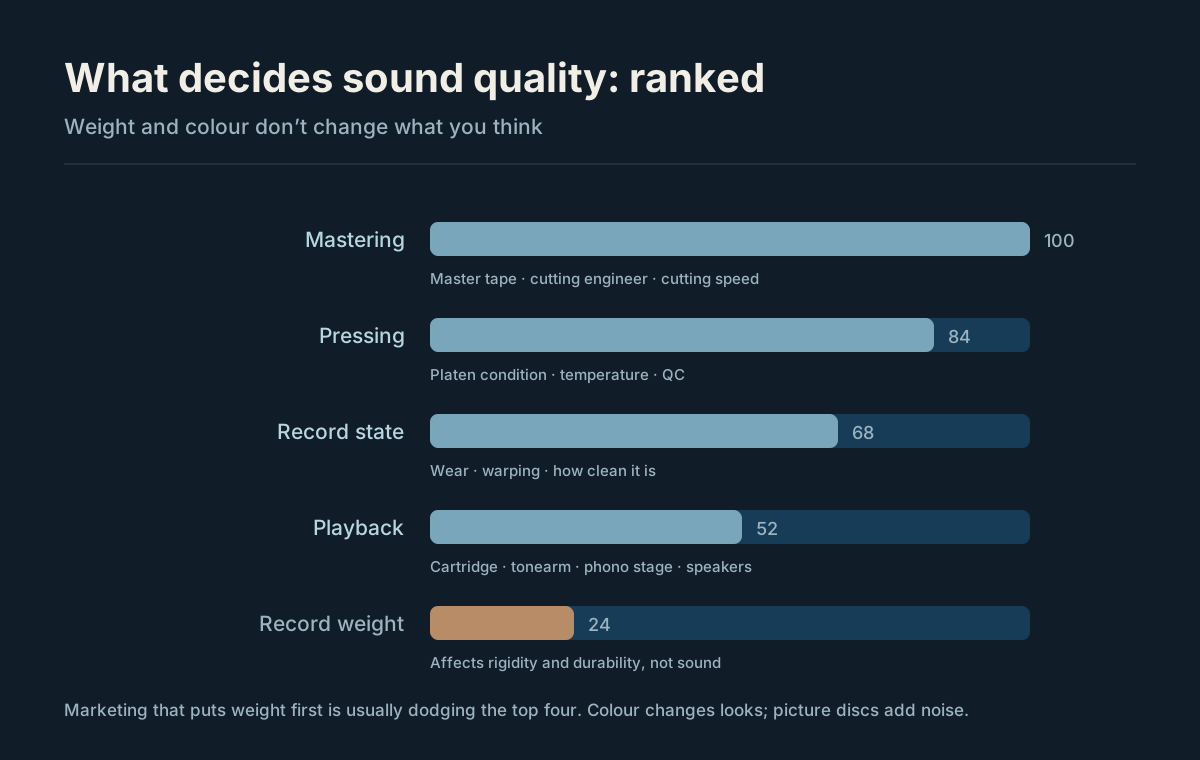
Illustration: Weight affects rigidity and durability, not directly changing sound quality.
Key Points at a Glance
- Standard vinyl typically weighs between 120 and 155 grams (most standard pressings are about 140 grams); 180g is a thicker pressing, affecting rigidity and durability.
- Weight does not directly change sound quality. Sound depends on groove shape and mastering, not the thickness of the PVC.
- The ranking of factors affecting sound quality is roughly: master and cutting, pressing quality, record condition, playback system, record weight.
- Colored vinyl uses PVC mixed with pigments; noise levels depend on the formula and pressing quality, and high-quality colored vinyl can sound just as good.
- Picture discs sandwich a printed image between two layers of clear PVC, typically have higher surface noise, and are more suited for collection and display.
- "180g" is a specification, "audiophile-grade" is a marketing term, and "half-speed mastering" is a process description—the information value of the three differs greatly.
What Weight Changes Is Rigidity
Standard vinyl typically weighs between 120 and 155 grams (most standard pressings are about 140 grams); 180g is a thicker pressing. The extra material brings two practical effects:
- Better resistance to deformation. Thicker records are more rigid and less prone to warping under heat, pressure, or long-term stacking.
- Flatter and more stable. The flatness of the record surface helps tracking, especially for tonearms and cartridges with average tracking ability.
Beyond that, you may see claims like "heavier records act like a flywheel, spinning more stably." Records do have rotational inertia, but treating it as a primary source of sound quality improvement is an exaggeration. The speed stability of a turntable system is mainly determined by the turntable, bearing, and drive method; the record's own mass is just a small variable.
A frequently overlooked counterpoint: heavy does not equal flat. Pressing temperature, cooling time, and mold condition determine whether the record surface is flat. A badly pressed 180g record may have greater absolute edge undulation than a flat 120g record, making the slope the tonearm must handle steeper. So "thicker" and "flatter" must be verified separately.
What Determines Sound Quality
Ranked by degree of influence, it's roughly as follows:
- Master and cutting. The source of the master, the cutting engineer, and the cutting speed determine how much information is actually cut into the grooves.
- Pressing quality. Mold condition, temperature control, and quality control standards determine how completely that information is replicated.
- Record condition. Whether it's worn, warped, or clean.
- Playback system. Cartridge, tonearm, phono stage, speakers, and their matching and setup.
- Record weight. Mainly affects stability and durability.
The significance of this ranking is that promotions placing weight first are usually avoiding the first four items. When buying, you can verify this order using different versions of the same album: two records from the same master, same pressing plant, and same condition will usually differ less than records from different master sources.
To verify whether the ranking holds, there's a low-cost method: find two versions of the same album, fix the volume, phono settings, and listening position, change only the record, and listen first to a passage near the inner grooves. The inner grooves are where the linear groove speed is lowest, so differences in cutting and pressing are most easily exposed there. If the differences between the two versions are small in both quiet passages and inner-groove sections, then the extra premium you paid is likely buying other attributes.
Another common misconception is conflating "improving the playback system" with "improving the record version." Upgrades to the cartridge, tonearm, and phono stage usually bring more noticeable changes than switching to another version of the same album.
To understand the principles of how grooves reproduce sound, see How Vinyl Works; to understand the relationship between speed and cutting, The Battle of the Speeds goes into more detail.
What 180g Really Buys You
Putting weight back in its proper place, it still has clear value, just not in the "sound quality" column:
- Better resistance to deformation for long-term storage. If your storage environment isn't ideal, you need to move records often, or you live in a place with large temperature swings, rigid records are less worrisome.
- More friendly for second-hand circulation. Thicker records are more likely to remain flat after multiple shipments and plays.
- Feel and handling. Thicker, heavier records feel more stable in hand, and sit better on the turntable and in storage.
- The costs also exist. Increased weight shows up in shipping costs and storage space, and it's worth factoring these in when buying heavy records.
If what you care about is long-term preservation, 180g is a reasonable bonus; if what you care about is "this version sounds better than that one," then what you need to look at is the cutting information, not the gram weight.
There is a spec difference more substantial than gram weight that is often overlooked: rotational speed and groove spacing. For the same 12-inch record, cutting the content at 45 RPM means longer grooves per unit of time and more amplitude headroom during cutting, making it easier to fully cut high frequencies and wide dynamic passages. The cost is shorter playable time per side, often requiring splitting across two records. If you are torn between two versions, and one of them is 45 RPM with a reliable mastering source, that difference is more worth your attention than the difference between 180g and 120g.
Colored Vinyl: What Pigment Changes
Colored records mix pigment into the PVC. The common claim is that "colored vinyl has more noise," but that claim is too general. The actual situation depends on the formula and pressing quality:
- Pigment and formula. The degree of pigment particle dispersion and its compatibility with PVC affect the consistency of the material, which in turn affects the noise floor. A well-made colored formula can be very quiet.
- Pressing quality. With the same formula, results from different plants can differ noticeably. When colored vinyl has problems, the problem is often in the pressing stage, not the color itself.
- Regrind. Pressings that use regrind material are more likely to introduce impurities, and these "eco-friendly" versions do not necessarily have an advantage in noise floor—that is also part of being honest.
In other words, color itself is not a sound quality grade. What really deserves attention is that these versions are often released in small batches through limited channels, with fewer production runs and a relatively higher probability of quality variation.
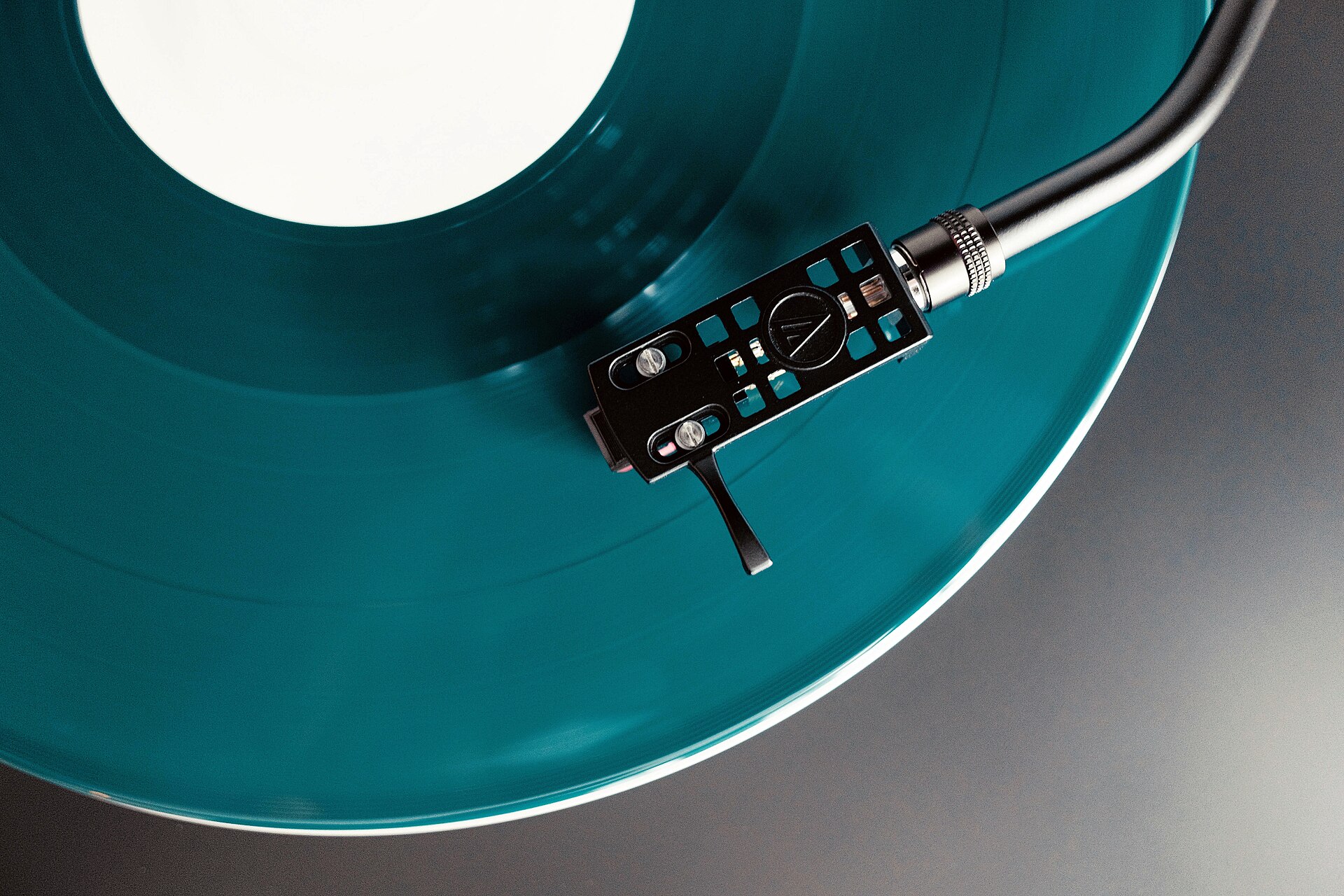
Colored vinyl uses PVC mixed with pigment; well-pressed colored vinyl can sound just as good.
There is also a practical difference in use: on light-colored, transparent, and colored surfaces, dust, fingerprints, and fine scratches are all less visible to the naked eye than on black surfaces. When you get a colored record, it is advisable to look at the surface at an angle under strong light and clean it once before putting it on the turntable; do not judge its condition just because it "looks pretty clean." For methods of judging wear and condition, you can refer to the condition grading guide.
The Structural Cost of Picture Discs
What deserves more caution is the picture disc. Its structure sandwiches a printed image between two layers of transparent PVC, with the grooves cut into the transparent layers. This structure itself brings several results:
- Noise floor is usually higher. The transparent layer where the grooves sit is made of a different material from ordinary black vinyl, and with the interlayer interface, surface noise is more easily heard.
- Harder to make perfectly flat. Multilayer structures are harder to control during pressing and cooling, so picture discs have a higher probability of slight warping.
- Lifespan and feel. The edge treatment and thickness of picture discs are often different from ordinary records, and the feel when storing and playing them is different too.
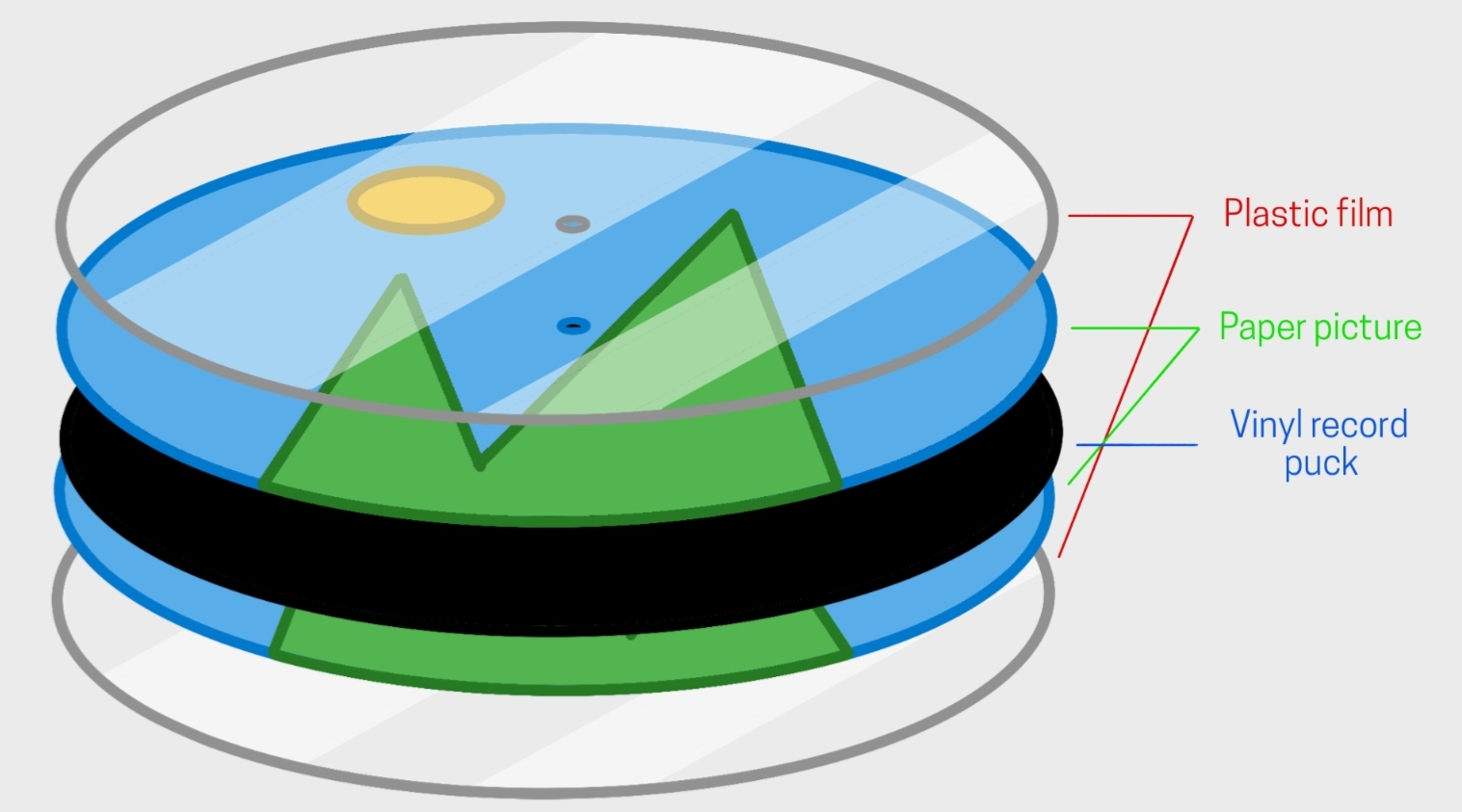
A picture disc sandwiches a printed image between two transparent PVC layers, with grooves cut into the transparent layers, so the noise floor is usually higher.
So the positioning of picture discs is very clear: collectibles and display items. For the best listening version, the black vinyl or colored vinyl of the same album is usually more suitable; for visuals and collecting, picture discs have an irreplaceable place. Both reasons are valid, as long as you know which one you are buying.
Transparent, Splatter, and Other Variants
Besides solid colors and picture discs, there is a series of approaches worth looking at separately:
- Transparent and translucent. Visually appealing, but they also have the problem that flaws are hard to notice, especially fine lines in the inner groove and run-out area.
- Splatter, marbled, and splashed. Every copy has a different pattern, giving strong collectible appeal; material consistency depends on factory control.
- Shaped discs. Non-circular cutting affects tracking and stability, making them more suitable for display; be cautious with everyday playback.
- Special processes such as glow-in-the-dark and liquid-filled. Their novelty value outweighs their listening value, and the criteria for judging them are similar to those for picture discs.
The common point of these versions is: high visual recognizability and a strong limited-edition narrative, which makes premiums easy to appear. To judge whether they are worth buying, use the same method as for judging any limited edition—look at whether it is truly scarce and whether it fits your collecting theme, rather than how special it sounds. If you are buying colored vinyl or a shaped disc to complete a collecting sequence, the appearance itself is the value; if you are buying it to replace the copy you play every day, first confirm the pressing reputation before deciding.
How to Read Promotional Language
In the same printed position, different wording carries very different amounts of information. You can read it according to the following set of comparisons:
- "180g" is a specification. It describes weight, not a promise of sound quality. Specifications can be verified and are the least ambiguous.
- "Audiophile" and "Hi-Fi" are marketing terms. They don't point to any verifiable process and usually need other information to back them up.
- "Half-speed mastering" is a process description. The master source and the cutting lathe run at half speed simultaneously (the RIAA curve also needs to be adjusted accordingly), giving the cutting stylus more time to handle high-frequency information. It has the potential to bring improvements on a good system, but not everyone can hear the difference, and it's not a guarantee of quality—the result still depends on the master source and the cutting operation.
- "Remastered" is a process description. You need to know what the source is, who handled it, and whether it started from the original master tape.
- "Limited" needs a number to back it up. A limited edition without a published quantity is just an adjective.
A useful habit: translate the promotional language into "which part of the chain does it claim to change?" If the answer falls on mastering or cutting, it may affect the sound; if it only falls on weight, color, or packaging, it affects the user experience and collectible attributes.
Among these terms, the one most worth verifying is the master source. Common statements in release notes include: cut from the original analog master tape, cut from a safety copy, cut from digital files, and re-cut from a vinyl rip. Their impact on sound is far greater than weight and color, but they're also the information least likely to be visible from the packaging. Verifiable clues include whether the label discloses the master source and processing chain, and whether the cutting engineer is credited. If all this information is missing, it's safer to treat "audiophile" as a wish rather than a description.
When It's Worth Paying More
Ask these questions in order, and the answer will be much clearer:
- If you care about long-term preservation. 180g is indeed more durable and worth considering, especially in average storage conditions.
- If it's for collecting a specific look. Colored vinyl and picture discs have clear collectible value. Paying for appearance is a legitimate reason—no need to find a sound-quality excuse for it.
- If it's for the best sound. Prioritize master source and cutting information over weight and color; also confirm the pressing plant and quality-control reputation.
- If it's for everyday listening. A standard-weight record with good pressing quality will likely sound better than a poorly pressed 180g record.
- If buying secondhand. Condition over specifications. A NM copy of a regular edition beats a VG limited colored vinyl. For grading standards, see Discogs' condition guide.
Before buying, ask yourself one question: the extra money I'm paying—am I buying sound, durability, or appearance? All three answers are valid, but be clear about which one you're buying.
Storage Methods Amplify or Cancel Out These Differences
Differences from specifications are often overshadowed by how you use them. Whether 120g or 180g, the following points are common prerequisites:
- Store vertically. Long-term flat stacking puts continuous pressure on the records below; even thicker discs can't withstand it.
- Avoid heat sources and direct sunlight. Temperature differences and localized heating are one of the main causes of warping—far more important than weight.
- Choose inner sleeve material carefully. Long-term contact with low-quality PVC inner sleeves can cause plasticizer migration, leading to hazy marks on the record surface that are hard to remove. This type of damage is irreversible.
- Clean before storing. Dust left in the grooves is both unsanitary and accelerates wear—a cost greater than any specification difference.
- Document your collection. Record version, color, pressing plant, and purchase condition. It will save you a lot of trouble when assessing value or avoiding duplicate purchases later. For methods, see Managing Your Record Collection with GROVV.
Do these things well, and the gap between colored vinyl, picture discs, and 180g will narrow; conversely, poor storage will make any specification advantage meaningless.
Frequently Asked Questions
Does 180g really sound better?
Not directly. Greater thickness brings advantages in rigidity, flatness, and durability. The sound itself is determined by groove shape and mastering. A poorly pressed 180g record may sound worse than a well-pressed standard-weight record.
Does colored vinyl wear out more easily than black vinyl?
There's no universal conclusion. Wear depends more on material formulation, pressing quality, stylus condition, and tracking setup than on color. What to watch for is that colored vinyl is often produced in small batches, so quality may vary more between batches.
Are picture discs suitable for everyday listening?
They can be played, but they're usually not the best choice. Their structure results in higher surface noise and makes it harder to achieve perfect flatness. If your system is sensitive to surface noise, or if you mainly listen with headphones, it's better to keep picture discs for collection and display.
Does the term "audiophile" have any real meaning?
It has no universal standard and is a marketing term. Focus on verifiable information: master source, cutting engineer, cutting speed, pressing plant, and whether the label discloses these details.
Is half-speed mastering worth paying more for?
It's a process with real significance, giving the cutting stage more headroom for high frequencies, but it doesn't guarantee the final result. If you have a chance to compare by listening, let your ears decide; if you can only read descriptions, first confirm the master source, then consider whether to pay for the process.
Weight, color, and printed labels are only some of a record's attributes, and they happen to be the parts most easily photographed and written into product titles. What truly determines whether this record is worth buying and how it sounds is mostly printed on the inner ring and in the release notes, and it takes an extra two minutes to find. Spending those two minutes is more rewarding than comparing gram weights and colors in front of the shelf.
Image Credits
The photos in this article are taken from Wikimedia Commons and used under the licenses noted for each image; the illustrative diagrams were made by GROVV.
- Colored vinyl uses PVC mixed with pigment, and well-pressed colored vinyl can sound just as good: M. Johnson · CC BY 2.0 · Source
- Picture discs sandwich a printed image between two layers of transparent PVC, with the grooves cut into the transparent layers, and surface noise is usually higher: TwentytwoAug · CC BY-SA 4.0 · Source

