When the stylus jumps to the next groove, the first instinct is often to fix it. But before taking action, it's worth asking a more basic question: is this a scratch, a pressing defect, or dust? These three causes correspond to completely different approaches, and what works for one may cause irreversible damage to another.
This guide aims to provide a clear framework for judgment: first distinguish between reversible and irreversible, then decide whether to take action and to what extent. The conclusion is actually not complicated, because problems caused by dirt and static can be handled, physical damage basically cannot be repaired at home, and the vast majority of so-called repair remedies carry risks far greater than benefits.
An easier principle to remember is: any method that requires you to apply mechanical force or heat to the record surface should be assumed to cause damage. The record's information layer is hidden in the grooves, far more fragile than it appears.
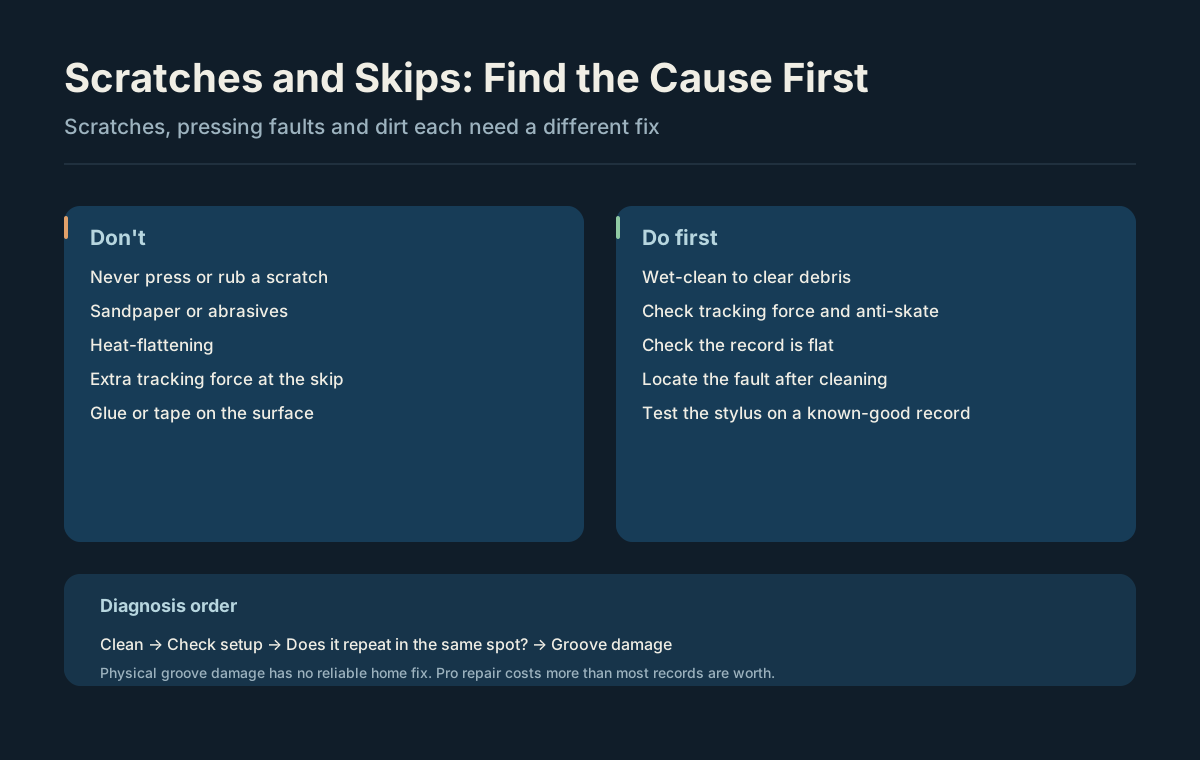
Illustration: There is no reliable home repair method for physical damage.
Key Points at a Glance
- Classify before acting: scratches and pressing defects are physical problems; dirt, debris, and static are the issues that can be addressed.
- The first step for any skip is thorough cleaning. A considerable number of problems disappear after cleaning.
- There is no reliable home repair method for physical damage. Pressing with fingers, sanding, or heating to flatten will expand the damage.
- Increasing tracking force only masks symptoms, at the cost of accelerating wear on both the record and the stylus.
- The cost of professional repair equipment usually exceeds the value of most records themselves; when intact audio is needed, transcription and digital restoration are often more realistic directions.
- Keeping a flawed old record is a reasonable choice; the key is to accurately document where the problem lies.
First Distinguish Between Reversible and Irreversible
Determining the nature of the problem is more important than rushing to address it. You can start by matching it against the following checklist:
- Scratches: Visible linear marks, usually causing repeated skips or pops at the same location. This is physical damage and irreversible.
- Pressing defects: Present when newly opened, fixed in position, with poorly formed grooves themselves, such as insufficient filling (non-fill). This is a manufacturing issue and irreversible.
- Dirt and debris: Position may vary, improves after cleaning. Can be addressed.
- Warping: Uneven disc surface, may cause fluctuations or skips throughout the entire rotation. Mild cases may be barely usable, severe cases cannot be corrected at home.
- Static and attraction: Dust attraction in dry environments, significantly improves after cleaning and anti-static treatment. Can be addressed.
First categorize the problem into one of the above, then decide the next step. Repeatedly cleaning and playing physical damage as if it were dirt will only increase wear.
The First Step Is Always Thorough Cleaning
Regardless of the final conclusion, the first step is to thoroughly clean the record. This is both a treatment and a diagnostic: if the problem disappears after cleaning, the cause is on the surface; if the problem remains exactly in the same position, then it's time to suspect the grooves.
- Use a suitable wet cleaning method: Cleaning solution with a record brush or cleaning machine, working along the groove direction, letting the liquid carry dirt out of the grooves, then rinsing away residue with distilled water.
- Let the record dry completely before playing. Residual liquid and the dust that follows will bring new noise.
- Replace with a clean inner sleeve to avoid the freshly cleaned record being contaminated again by debris in the inner sleeve.
- Address static: Use anti-static inner sleeves, carbon fiber brushes, or anti-static devices to reduce dust attraction.
- Clean the stylus: When the record is very dirty, deposits also accumulate on the tip. Both sides clean makes diagnosis reliable.
- Do not use household cleaners or alcohol-containing formulas on shellac records. 78 RPM records are mostly pressed from shellac, which has different material properties from vinyl. Alcohol-based solvents will erode their surface, and cleaning methods need to be differentiated. For the differences between the two materials, refer to the explanation about shellac.
After cleaning, listen again to the problematic section. This is the most informative step in the entire troubleshooting process.
Scratches: What You Can Hear, What You Can See
Symptoms caused by scratches follow fairly consistent patterns. They usually manifest as short, repeated pops synchronized with the rotation speed; if the scratch is deep, the stylus is pushed off its original path, resulting in a skip or a loop stuck in the same section.
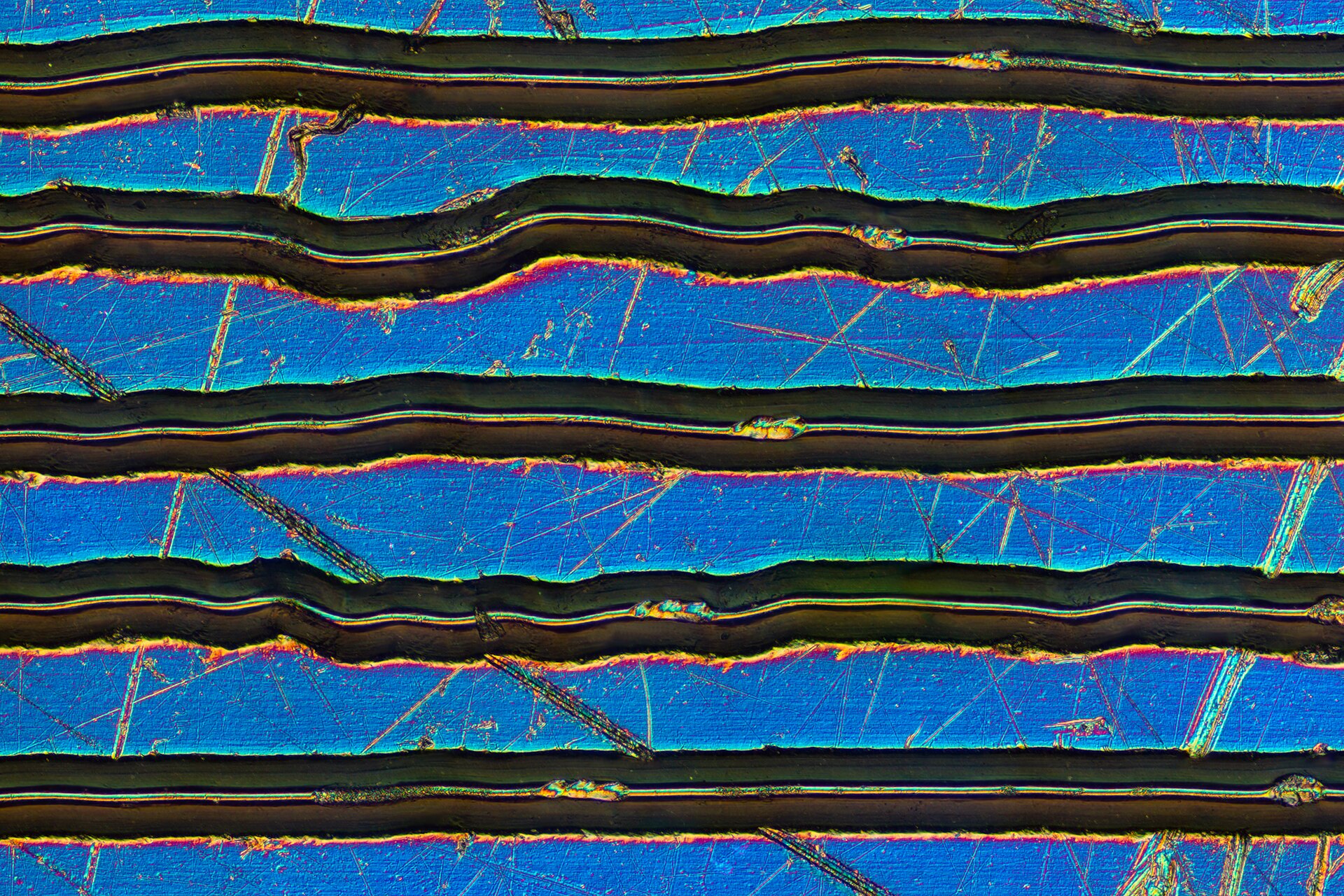
When magnified, the actual damage to the grooves from a scratch becomes visible; there is no reliable home repair method for this type of damage.
Viewing the disc surface at an angle under strong side light can help assess the extent of damage:
- Surface scuffs: Only affect gloss, the stylus tip may not read them at all, usually inaudible.
- Transverse scratches crossing the grooves: Interrupt multiple grooves, producing a series of pops.
- Scratches nearly parallel to the grooves: May affect only a very short section, but are audible because the stylus tip continuously reads them.
- Areas where groove sidewalls are crushed: May not be visually obvious, but cause continuous distortion.
There is an important distinction here: the consequence of a scratch depends on whether it destroys the sidewalls carrying the modulation, not on how obvious it looks. A seemingly deep surface scuff may be harmless, while an inconspicuous indentation may ruin an entire passage of music. Therefore, judgment should be based on listening and position, not appearance.
Pressing Defects, Off-Center, and Warped Edges
Some problems are not caused by use, but exist when the record leaves the factory:
- Non-fill: During pressing, the material does not completely fill the grooves, resulting in a continuous hiss or tearing sound, usually in a specific area, and cleaning cannot improve it.
- Off-center: The center hole is misaligned, causing periodic pitch fluctuations, especially noticeable on the inner grooves.
- Warping and uneven records: Improper transport and storage are common causes, and pressing and cooling control can also contribute. In severe cases, it can make the tonearm move up and down, or even skip.
- Pressing noise: Background noise from materials and manufacturing, inherent to the record.
The common points of these problems are that the location is fixed, cleaning is ineffective, and changing the stylus does not help. For new records, the most reasonable approach is to contact the seller within the return/exchange period; for old records, you can only accept it or find another copy in better condition.
Troubleshooting order for skipping
When encountering skipping, follow the order below to narrow down the scope in the shortest time:
- Stop playback and lift the tonearm. Do not repeatedly force play at the skipping position; that will only increase damage.
- Thoroughly clean the record and stylus to remove debris and buildup.
- Check whether the tracking force and anti-skate are within the manufacturer's recommended range. Low tracking force is one of the most common causes of skipping.
- Confirm the turntable is level, and check whether the record is flat and whether the center hole is too loose.
- Try a known good record for comparison. If the new record also skips near the same position, the problem may be in the system setup; if only this record skips, the problem is with the record.
- Confirm whether the position is fixed. If it occurs only at one fixed position and cleaning is ineffective, it can basically be determined to be groove damage.
After completing this process, you will at least have a clear conclusion: whether it is a setup problem, a record problem, or both.
Dangerous folk remedies: why not to try them
There are many repair methods circulating online, but most of them violate the same principle, which is that they require applying mechanical force or heat to the record. Common categories:
- Pushing scratches with fingers or hard objects: It may seem to flatten the raised part, but in reality it crushes the local grooves, turning a fine scratch into a distorted area.
- Treating the surface with sandpaper or abrasive materials: Directly damages the grooves, and the damage is irreversible.
- Heat flattening: Temperature and force are difficult to control precisely, easily causing new deformation, or even changing the groove shape.
- Increasing tracking force at the skipping position: It may solve the skipping in the short term, at the cost of accelerating groove and stylus wear, and the problem will return in a more serious form.
- Using glue or tape on the record surface: Residue is extremely difficult to remove, and adhesive may remain on the stylus tip.
- Forcing playback with an unsuitable stylus: For example, using a fine LP stylus on a 78 rpm shellac record. 78 rpm records usually require a coarse stylus of about 3 mil, while LP is about 0.7 mil. Using the wrong stylus will scrape new damage into the grooves.
These methods often appear effective because they change the location where the symptom appears, rather than fixing the problem.
Warping and flattening: why it's hard to do well at home
Warping can be measured: place the record on a flat surface and observe the edge fluctuations, or observe the up-and-down movement of the tonearm during playback. Slight fluctuations are usually still playable, but obvious warping can cause tracking problems.
The ideal method is to place the record between flat, clean glass plates with even pressure, and slowly restore it at a suitable temperature. The problem is that it is difficult for a home environment to satisfy all these conditions at once: if the temperature is too low, there is no effect; if too high, the vinyl will soften or even change the groove shape; uneven pressure will create new unevenness; and once it fails, the damage is irreversible. In comparison, treating it as a flawed but listenable record, or finding another flat copy, is often more cost-effective.
Professional repair and transcription: realistic options
When physical damage does exist, and you must hear the intact content, the realistic direction is to bypass the damage rather than repair it:
- More meticulous playback methods: More suitable stylus shapes and more precise alignment can sometimes improve tracking ability and reduce pops in damaged sections. This is optimizing playback, not repairing the record.
- Professional cleaning equipment: Ultrasonic or vacuum cleaning machines are more thorough than manual cleaning and effective on stubborn dirt, but they can also only deal with surface dirt.
- Digital processing after transcription: Record the record into digital files, then use audio software to handle pops and short noises. This is currently the most reliable way to make the content sound good, provided the damage does not prevent the stylus from passing through.
- Professional repair services: There are indeed professional treatments for records, but equipment and labor costs usually exceed the actual value of most records. Whether it is worth it depends on what this record means to you.
It should be noted that transcription does not change the condition of the record. Its value lies in preserving the content, not in making the record usable again.
Documenting the flaws
If you decide to accept a problematic record, the most useful thing is to document the problem:
- Mark the problem's location. Note which side, which track, roughly what time point, and whether the symptom is a pop, a skip, or a loop.
- Record the treatment history. How many cleanings, what methods were used, whether other copies have been tried. Next time a similar problem comes up, you won't have to repeat the troubleshooting.
- Be honest when passing it on. This is part of the condition description and directly affects buyers' price expectations. For grading systems and how to describe, see the Vinyl Condition Grading Guide and Discogs' grading explanation.
- Manage it consistently in your collection system. Keeping condition, flaw locations, and purchase information in the same record makes searching much easier; the Collection Organization Guide and Managing Your Collection with GROVV offer two different approaches.
These records may seem trivial, but they are the most direct basis when deciding whether to buy a better copy.
Acceptance Is Also a Choice
An old record with slight scratches may still be worth owning. The scratch may affect only a second or two, with the rest intact; pressing noise may become inaudible once the music starts. What really needs to be avoided is turning a listenable record into an unlistenable one because of an unsuccessful repair.
This is also the practical attitude of many secondhand record collectors: a record's history is written on its surface. Rather than trying to erase the traces, understand them, record them, and put your attention back on the music when listening. For related thoughts, see Why I Listen to Secondhand Vinyl.
Frequently Asked Questions
Can a skipping record still be saved
It depends on the cause. If the cause is debris, built-up grime, or static, a thorough cleaning usually solves it; if the cause is a scratch, pressing defect, or warp, there is no reliable home repair. Clean first, then check the setup, and only then draw a conclusion about the record.
Can repeated playback wear away a skip
Sometimes the stylus brings loose foreign matter out of the groove and the problem disappears. But for a genuine physical obstruction, repeated playback only makes the groove at the obstruction worse and wears the stylus faster. If it skips at the same spot two or three times in a row, stop trying.
Can increasing the tracking force push past a scratch
It may stop skipping in the short term, but at the cost of accelerated groove and stylus wear. Tracking force should stay within the manufacturer's recommended range; treating it as a repair method will cause longer-term damage.
If it still skips after cleaning, does that mean it wasn't cleaned well enough
Possibly, but more likely the cause is not dirt. The criterion is: after cleaning, does the symptom still appear at the same location and the same time point? If the location is completely fixed and there is no improvement at all, it should be treated as groove damage.
Is professional repair worth paying for
It depends on what this record means to you. The cost of professional repair is usually higher than the actual value of most records, so the more common alternatives are transferring it to a digital file and processing the audio, or simply replacing it with a better copy.
Stop the Damage Where It Is Now
When a record skips, the hardest part is often not the technique, but resisting the urge to fix it. Clean first, then compare, then accept the conclusion; this process looks conservative, but it prevents turning a listenable record into an unlistenable one.
What you can control is keeping it clean, setting it up correctly, and recording it honestly. Leave the rest to the record's own history.
Image Credits
Photos in this article are taken from Wikimedia Commons and used under the licenses indicated for each image; diagrams are made by GROVV.
