In a second-hand shop, a record's back cover says "1973." This number is usually not fake, but it describes the year of the work or first release, not the time this record left the pressing machine.
The same master tape can be reissued repeatedly over decades: reusing old sleeve artwork, copying the copyright line from the original, and keeping the catalog number unchanged are all standard practices in the record industry. The result is that the same "1973" can appear on a first pressing from 1973, on a 1980s reissue, or even on a recent reissue. The seller isn't lying when they list that year, but it doesn't answer the question you're asking.
The good news is that the pressing date isn't a mystery. Records are industrial products, and every manufacturing step leaves traces: inner groove codes, label layout, sleeve printing, company information, packaging accessories. These traces come from different stages and vary in reliability. The right approach isn't to find one "decisive piece of evidence," but to let several independent clues corroborate each other.
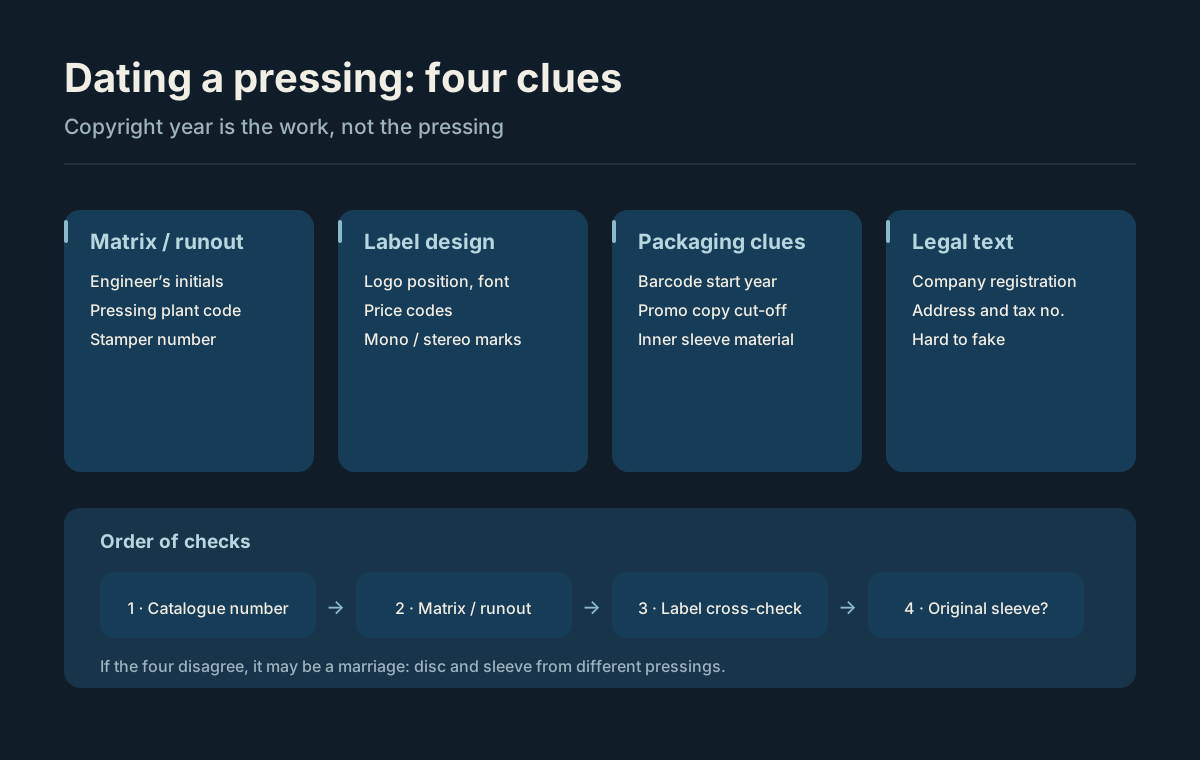
Diagram: The copyright year is the work's year, not the pressing year.
Key Points at a Glance
- Copyright year, first release year, and pressing year are three different things; the number on the back cover can only be taken as a lower bound.
- The inner groove codes (matrix / runout) are the hardest evidence, but you must first distinguish etched from stamped text; they come from different stages.
- Factory codes, cutting engineer signatures, and stamper numbers can narrow the range to a specific factory and period.
- Label layout, price codes, and copyright line wording are the easiest set of clues to cross-verify.
- Barcodes, CD promotional text, and inner sleeve material can only give a rough lower bound; they are unreliable when used alone.
- Only when several clues point to the same time period can you draw a conclusion; if they contradict each other, first suspect that the record and sleeve are a "marriage."
First, Distinguish the Three "Years"
The first step in determining the pressing date is to separate concepts that get mixed together. In second-hand trading, at least three years are being used simultaneously:
- Work or copyright year. The © on the sleeve refers to copyright for artwork, text, etc., while the ℗ on the label refers to recording copyright. They describe when this recording and this design were born.
- First release year. The time this album first went on sale. Reissue sleeves usually keep this number because it is the work's identity information.
- Pressing year. The time this specific record in your hands was pressed. The same version may be pressed repeatedly in different years and at different factories, and each pressing counts as a new pressing batch.
Only the third is what really matters in discussions of sound quality, condition, and price. A record labeled 1973, if its inner groove codes show it came from a factory that only opened in the 1980s, is a 1980s product, and the back cover number has nothing to do with it.
One more easily overlooked point: the catalog number usually stays the same within a single release, and reissues, factory changes, and packaging changes may continue to use it. So the catalog number can help you locate "which version family this is," but it cannot by itself tell you when this particular copy was pressed.
Start with the Inner Groove Codes
The inner groove codes (matrix / runout) refer to the strings in the blank area of the record's runout area where there are no audio grooves. They are inscribed on the disc itself and belong to a different system from the information printed on the label; they are usually also the part hardest to alter at will.
When reading inner groove codes, first divide them into two categories by origin:
- Etched text. Cut into the lacquer by the cutting engineer; after transfer to the stamper, it retains a handwritten-style character shape. Here you can see the recording number, master source markings, and the cutting engineer's signature initials.
- Stamped text. Impressed by the stamper; the characters are regular and mechanical. Here are usually the pressing plant code, stamper number, and side identifier.
This distinction is crucial. Etched text tells you which set of masters and which cutting this record used; stamped text tells you which factory pressed it and with which stamper number. The time periods they point to may be far apart, for example when an old master is sent to a new factory for repressing.
Factory Codes and Cutting Engineer Signatures
Each pressing plant has its own abbreviation code, and these codes change as factories open, close, or are acquired. Seeing a code gives you a time window: if the plant only started taking orders after a certain year, then this record cannot be earlier than that year. Conversely, a factory that has already closed cannot appear in later pressings.
Cutting engineer signatures are equally useful. A signature is a personal mark, and working years can be verified; the same engineer's cuts from different eras show changes in handwriting, abbreviation style, and even numbering habits. For collectors, a certain engineer's name may itself imply a sonic preference, which is often mentioned when choosing reissues.
The stamper number usually indicates which stamper in the same pressing run this is. The number increases as stampers are replaced, so a higher number generally means it is a newer stamper swapped in later in the pressing process, rather than the same stamper being used many times. This number is only meaningful when compared within the same pressing run.
What If There Are No Inner Groove Codes
A few records have blank inner grooves, or only the catalog number repeated from the label. This is common on early pressings, some small labels, and certain non-retail versions. In this case, do not force a conclusion; rely instead on label and sleeve clues, and lower your level of certainty by one notch.
What the Label Layout Tells You
The label is where record companies put effort, and its design changes with corporate restructuring, trademark updates, and legal requirements, and these changes often have clear chronological correspondences. You can look at them in the following order:
- The logo itself. Font, composition, color, and the position of encircling text are almost always adjusted with every corporate identity update. Different renderings of the same logo usually correspond to different periods.
- Copyright line wording. Changes in a record company's full name are the most direct chronological indicator; labels printed after a company rename will no longer use the old full name.
- Price code. Price codes are products of the label system, and their appearance and removal have clear time frames. The same catalog number paired with different price codes often indicates different repress batches.
- Mono and stereo indicators. Early on, text explanations were used; later, they gradually standardized to the fixed word "STEREO"; still later, many labels stopped marking it altogether. Changes in how it is indicated are themselves a time scale.
- Promotional and channel markings. White labels, gold stamps, cut-out holes, or clipped corners are traces of promotion and inventory clearance. They differ from regular retail versions and must be considered separately when assessing value and era.
Look at label features together with confirmed matrix numbers: if the matrix numbers point to a certain period at a certain factory, and the label layout also matches the practices of that period, the two clues reinforce each other.
Sleeves and Packaging Provide a Lower Bound
The role of the sleeve is not to pinpoint the year, but to provide a "cannot be earlier than" lower bound. Its information is concentrated in a few places:
- Barcode. The widespread adoption of barcodes on retail records happened in the 1980s. A sleeve with no barcode at all usually means earlier; having a barcode means it cannot have been printed before the 1970s.
- Promotional text. Phrases like "also available on cassette" or "simultaneously released on CD" can anchor the lower bound. CDs only came on the market in 1982, so a version stating it was released simultaneously with a CD must be later than that.
- Printing information. Printer names, printing locations, paper, and lamination processes all change. Printing text on the sleeve corners often says more than the cover artwork.
- Sleeve structure. Single-page, gatefold, whether there is an insert, and whether the spine is printed all change with production budgets and eras.

The company name, address, and series number on the back cover change over time and are clues for dating.
Before barcodes appeared, version differentiation relied entirely on catalog numbers, printing information, and label layout.

Before barcodes became widespread, records were distinguished by catalog numbers and printing information.
Legal Text and Company Information
The small print on the back of the sleeve and along the label edges is often overlooked, but it has quite high temporal resolution.
- Company full name and legal form. From independent company to subsidiary, from partnership to limited company, changes in the name will show up in the copyright line.
- Address. Company relocations and factory address changes will update the printed content.
- Registration and tax information. Records in some countries and regions may bear registration numbers, tax numbers, or industry association marks. These contents are regulated, change infrequently, and once they change, they are reliable dividing points.
- Distribution and licensing information. Statements like "manufactured and distributed by a certain company" can indicate which market the record belongs to and who was responsible for pressing it.
These details are not easy to counterfeit, because counterfeiters prefer to copy the conspicuous cover artwork rather than re-typeset legal text word for word. For this reason, when compared with matrix numbers, their reference value is very high.
78s and Earlier Records
If what you have is a 78 rpm record, the dating logic needs to change. Most such records use shellac as the main material, their grooves are much wider than an LP's, and they require a much thicker stylus, usually around 3 mil, whereas LP microgroove records use about 0.7 mil. Using the wrong stylus will not only fail to produce normal sound but also damage the record.
Different materials leave different traces: shellac discs are more brittle and fragile, their matrix numbers appear differently from those on PVC records, and labels are often pasted directly onto the disc surface. More troublesome is the equalization curve. The RIAA curve was established in 1954 (derived from RCA Victor's 1953 New Orthophonic curve), but adoption times varied by country and label, and it was not basically unified until the late 1950s. Before that, each record company had its own equalization scheme, and playback required the corresponding settings, otherwise you would get a baffling sound. For the background on speeds and formats, see Battle of the Speeds.
Dating these old records relies more on labels and company history; the information provided by matrix inscriptions is limited.
A Sequence You Can Follow Directly
String the above clues together and follow the sequence below to avoid the most common misjudgments:
- First confirm the catalog number to narrow it down to a specific version. Use the catalog number to locate "this particular release" in a database, and be careful to distinguish entries for different countries, different plants, and different packaging.
- Read the matrix numbers to confirm the pressing plant and stamper. Note both the inscribed and stamped parts and check them separately.
- Cross-verify the era using label layout. Check whether the logo, price code, and copyright line are consistent with the conclusion from the previous step.
- Finally, check the sleeve and accessories to confirm whether they are original. Barcode, promotional text, inner sleeve, and insert belong to this step.
The order cannot be reversed. Looking at the cover art first and then finding evidence makes it easy to rationalize your first impression; starting with the catalog number and matrix number means the conclusion is derived from evidence.
What to Do When Signals Conflict
If the four clues contradict each other, the most common explanation is 'assembled': the record and sleeve come from different versions. This is very common in the secondhand market, especially for popular albums.
When you encounter contradictions, you can judge as follows:
- The disc is authoritative. When discussing sound quality and usability, the record itself decides everything; the sleeve only affects collectible completeness.
- Look at the direction of the contradiction. If the disc is newer than the sleeve, it was usually swapped; if the sleeve is newer than the disc, it was usually replaced.
- Check the accessories. Whether the inner sleeve, insert, poster, and obi match the version is an important basis for judging completeness.
- Be honest. If you are reselling, clearly state the inconsistencies; this protects you better than vague descriptions. For methods of condition description, see the Condition Grading Guide.
Assembled does not equal fake. It just means the record's history is more complex than a single version, and value judgments should be adjusted accordingly.
The Correct Use of Digital Tools
Online databases are the fastest way to organize clues, but you need to understand what they can and cannot do.
- Search by catalog number, then filter by country, year, and format. The same catalog number may correspond to multiple version entries; check the matrix number field one by one.
- Compare the matrix number string. Matrix numbers in databases are submitted by users, and the error rate is not zero. A completely matching string can be referenced; for clearly inconsistent ones, do not force a match.
- Look at sales records and median prices, not listing prices. Listing prices are the seller's expectation; sales records reflect the actual range. Such data is only for judging relative hotness and cannot replace judgment of specific condition.
- Treat the database as an index and the physical item as evidence. What ultimately confirms the date is always the text on the record in your hands.
If your collection is already sizable, recording this information will save you a lot of trouble. Using tools to organize versions, pressing plants, and sources is more reliable than relying on memory; for specific methods, see Managing Your Record Collection with GROVV.
Why Put in This Effort
Because the version directly affects three things. First is price: first pressings, reissues, and remasters of the same album are different things on the market, and confusing them can lead to overpaying or underselling. Second is collectible value: some versions have extra significance due to special cutting, pressing, or packaging. Third is sound: reissues may use better mastering, and first pressings may have different tonal tendencies due to the cutting method; which is better depends on your system and your own preferences.
There is another less-mentioned benefit of identifying versions: when you suspect a record is a counterfeit or bootleg, version clues are the first step. Missing matrix numbers, crude label printing, and obvious mismatches between sleeve and disc are all signals that need verification; you can check them one by one against How to Identify Counterfeit Records.
Common Questions
Is the year on the back cover really completely useless?
No. It can tell you which release this record belongs to and gives a lower time limit. Its problem is only that it cannot distinguish pressing batches of the same version in different years.
Can the matrix number pinpoint a specific year?
In most cases, it can only pinpoint a time window, such as a certain stage of a factory's operation or certain years when an engineer was on staff. To pinpoint a year, multiple clues must support it simultaneously.
Does having a barcode mean it must be from after the 1980s?
The widespread use of barcodes on retail records did occur in the 1980s, but the pace differed across markets and labels. A barcode can serve as supporting evidence for 'not earlier than a certain period'; do not treat it as the sole basis.
If the record and sleeve do not match, did I buy a fake?
Not necessarily. Assembled copies are very common in the secondhand market, especially for high-volume albums. Fakes usually come with more systematic signs such as abnormal matrix numbers, poor print quality, and labels and disc craftsmanship that do not match, requiring comprehensive judgment.
Is it worth spending so much time checking versions?
It depends on the record itself. For an ordinary reissue you listen to casually, a rough idea is enough; for a higher-priced record or one you plan to keep long-term, spending ten minutes checking the matrix number and label can often avoid a costly misjudgment.
Judging the pressing year is essentially not about memorizing a bunch of years, but about developing a habit: first look at the parts of the disc that cannot lie, then use printed information to corroborate, and finally acknowledge what you do not know. The record industry leaves enough traces; as long as you read them in order, most questions can get an answer with a reliable degree, rather than a hearsay claim.
Image Sources
The photos in this article are from Wikimedia Commons and are used under the licenses indicated for each image; the diagrams are made by GROVV.
- The company name, address, and series number on the back cover change over time, offering clues for dating: Gelpgim22 (Sergio Panei Pitrau) · Public domain · source
- Before barcodes became widespread, records were distinguished by catalog numbers and printed information: Marion S. Trikosko · Public domain · source

