Records are rarely worn out by being played; most are ruined by being stored. Warping, mold spots, scuffs from inner sleeves, and sour-smelling jackets—these problems are not caused by a single accident, but are the result of long-term storage methods. What they have in common is this: there is no warning when the problem occurs, and by the time you notice, months or even years have often passed.
This guide proceeds in order from greatest to smallest impact: first address orientation and force, then deal with the materials of inner sleeves and outer jackets, followed by temperature, humidity, and ventilation, and finally handling and regular inspection. Each section gives criteria you can check against, so you can inspect your own collection as you read and see where problems may already be quietly developing.
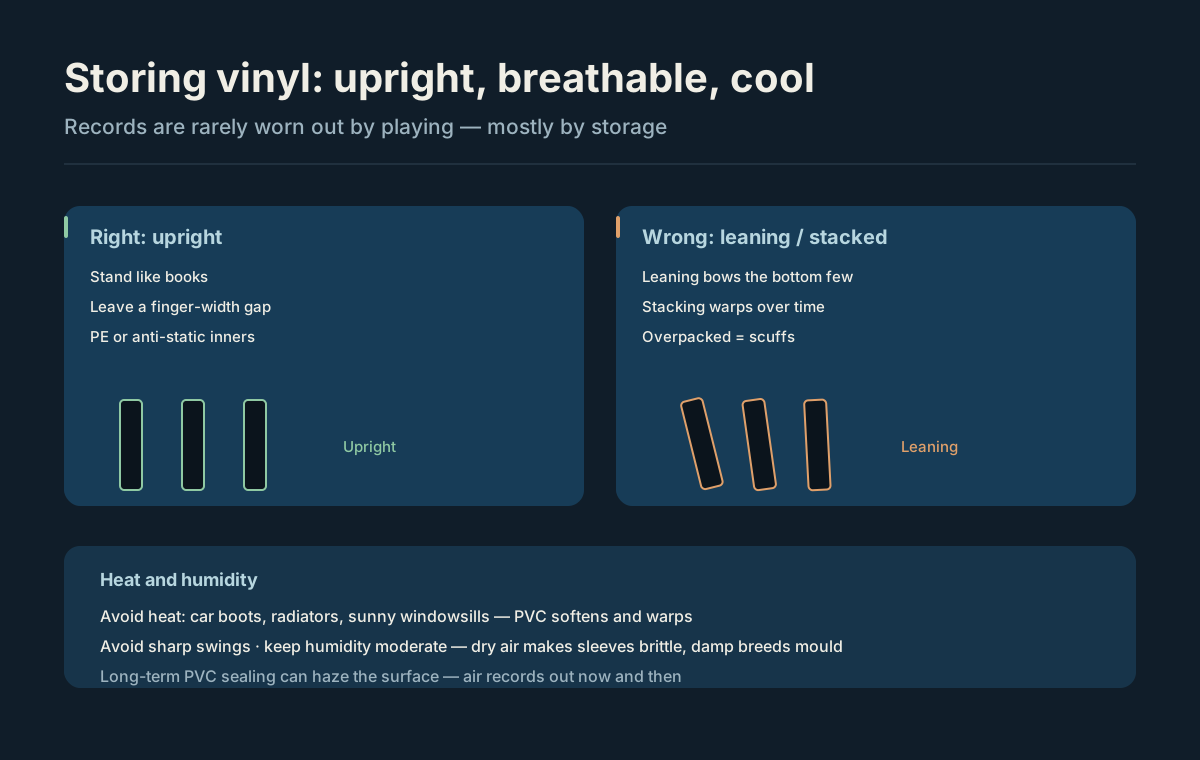
Illustration: store vertically, leave a finger's width of space, and avoid high temperatures and drastic temperature changes.
Quick Overview
- Store vertically and keep them upright. This is the safest method and the standard practice in archival institutions. Leaning and flat stacking both subject some records to long-term pressure.
- Do not pack them too tightly or leave them too loose. The ideal state is being able to easily push a record back into place with one finger.
- Inner sleeve material matters more than the outer jacket. Long-term contact between PVC and the record surface can cause hazing, while paper sleeves leave fine scuffs.
- The key to temperature is not "low" but "stable." Drastic fluctuations cause more damage than consistently slightly high temperatures.
- Keep humidity at a moderate level. Too dry makes paper jackets brittle; too damp breeds mold.
- Inspecting regularly (every six months to a year) is cheaper than any after-the-fact remedy.
Why Storage Method Determines Lifespan
A record's lifespan is determined by two parts: the contact between the stylus and the groove during playback, and all the time when it is not being played. The latter accounts for the vast majority. During the ten-plus years a record is not played, it is subjected to continuous, slow, even forces: gravity, humidity, temperature changes, and the chemical action of inner sleeve materials.
Individually, these forces are all very small, but they are continuous. A record leaning against a bookshelf may show no visible change in the short term, but over the long term (several years), visible warping will appear at the edge; when a record is pressed under a stack of records, the bottom few bear the full weight of everything above. Once warping forms, it is basically impossible to restore, because vinyl does not return to its original flat state on its own.
Understanding this makes it clear why storage rules seem fussy but are worth following: they are not aimed at today's sound, but at the condition ten years from now. If you also care about judging a record's value, the standards in condition grading also apply to self-inspection—warping, jacket wear, and inner sleeve marks are all items that would be recorded.
Store Vertically, and Keep Them Upright
Records must be stored upright like books, and kept basically vertical. Leaning puts the weight of the whole row on the bottom few, and over time they will inevitably warp. This is because records themselves are flexible; continuous lateral pressure makes them bend in the direction of the force, and once the bending exceeds the material's elastic range, it becomes fixed.
The specific criteria are:
- Viewed from the side, the edges of a row of records should form a nearly straight line, not a gradually sloping diagonal.
- If a single record cannot stand and always falls to one side, it is already slightly warped and should be placed flat alone on a stable surface for observation.
- Do not use heavy objects other than bookends to press them down hard; excessive pressure can also cause warping.
Stuffing records diagonally into a cabinet to save space is the most common mistake. What you save is a few dozen centimeters; what you pay is the whole row of records.

Flat stacking subjects the lower records to long-term pressure and is the most common cause of warping.
Tightness: Leave a Finger's Width of Space
Packing them too tightly and leaving them too loose both cause problems.
- Too crowded: when pulling one out, the record surface scrapes against the jacket edges of adjacent records, and after several times it leaves marks.
- Too loose: the records lean against each other, creating a new leaning state, which is equivalent to circling back to the previous problem.
The ideal state is being able to easily push a record back into place with one finger, while the whole row does not fall over when you let go. If you need both hands to yank a record out, the row is already too full and should be split into a second compartment.
The way you pull records out is also worth standardizing: use one hand to gently push the adjacent records aside, and use the other hand to support the jacket as a whole when taking it out. Do not just pinch the upper corner of the jacket and lift. The cardboard of the jacket will split from the corner after repeated stress, which is the most common type of jacket wear.

Storing vertically, leaving space, and avoiding direct sunlight are the three basic conditions for long-term preservation.
Inner Sleeve Material Matters More Than the Outer Jacket
The inner sleeve is the layer that directly contacts the record surface, and its material determines whether long-term storage will create new surface problems.
- Paper inner sleeves: cheap, but the paper surface rubs against the record surface. No problem in the short term, but repeated removal over the long term easily produces fine scratches, especially when there is slight dust on the record surface.
- Polyethylene (PE) inner sleeves: smooth and non-scratching, the most common alternative, and cost-effective.
- Anti-static polyethylene inner sleeves: combine anti-static properties with low friction, suitable for long-term storage, and can also reduce dust attraction.
- PVC inner sleeves: look transparent and attractive in the short term, but over the long term may react with the record, causing hazing on the record surface. Not recommended for long-term use.
One thing needs to be clarified here: the thick, transparent inner sleeves commonly found in used records are often made of PVC. They perform well when new, but after years of storage, plasticizers may leach out, causing a uniform hazy mark on the record surface. This type of hazing usually cannot be removed by cleaning, so when you find old PVC inner sleeves, replacing them is safer than keeping them.
When replacing inner sleeves, place them with the opening facing up, and offset the inner sleeve opening 90 degrees from the outer sleeve opening, so the record is less likely to slip out during handling.
Outer Sleeves and Protective Covers
The purpose of an outer sleeve is to block dust and friction, but its selection is relatively flexible, provided it does not impede breathability.
- If using plastic outer protective sleeves, choose a slightly larger size to avoid tightly wrapping the sleeve and causing pressure.
- Do not use shrink wrap to seal records long-term. It will tighten the sleeve and record together, which is not conducive to breathability and can damage the sleeve surface when opened.
- The sleeves themselves should be stored vertically and kept parallel with other sleeves; do not bend them just to fit into a small slot.
Additionally, keeping the sleeve dry is more important than keeping it clean. A damp sleeve is a breeding ground for mold, and once mold enters the cardboard, it is very difficult to remove, and ultimately the sleeve can only be replaced.
The Key to Temperature Is Stability
Many people only care about "whether the temperature is high," but the real problem is fluctuation. Vinyl expands and contracts with temperature, and repeated hot-cold cycles cause the record surface to undergo slight deformation inside the sleeve, affecting flatness over time. Severe temperature changes can also cause condensation to form between the record surface and inner sleeve, providing moisture for mold.
- Car trunks, near heaters, and windowsills with direct sunlight are all dangerous locations, especially in seasons with significant temperature differences.
- Do not place records directly in front of air conditioning vents; local temperature differences are more troublesome than overall temperature.
- When transporting, avoid taking records directly from cold outdoors into a warm room and immediately opening them; give the record some time to warm up.
- The ideal state for long-term storage is stable temperature with slow changes, rather than a specific number.
Humidity and Mold
Humidity is another main line in storage, and problems can arise at both extremes.
- Too dry: Paper sleeves become brittle, corners easily crack, and friction from paper bags increases.
- Too humid: Mold grows, cardboard softens, labels wrinkle, and in severe cases, mold spots appear on the record surface.
Basements and the plum rain season are the highest-risk combination. If conditions permit, use a dehumidifier to maintain room humidity at a moderate level; if no dehumidifier is available, desiccants can be used, but remember to replace them regularly, as saturated desiccants no longer work. Besides the plum rain season, the return of southerly winds in coastal southern regions also requires attention.
If you find the sleeve feels damp, first remove the record and let the sleeve dry separately in a ventilated place; do not dry it with the record inside.
Ventilation, and the Risks of Long-Term Sealing
Long-term sealing in plastic bags or shrink wrap, especially PVC materials in close contact with the record surface, may accelerate hazing of the record. At the very least, the sleeve should be able to breathe, or the record should be taken out periodically for inspection.
The purpose of ventilation is twofold: first, to allow volatile substances released by the inner sleeve material to disperse rather than remain near the record surface; second, to prevent moisture from being trapped inside the sleeve. For collections that are not played for long periods, taking them out and flipping through them regularly is more reliable than any passive protection.
While flipping through, also check: whether there are new hazy marks on the record surface, whether the inner sleeve has hardened or yellowed, and whether the sleeve has new mold spots. These three changes are very intuitive, and a row can be scanned in a few minutes.
Stacking and Handling
- Short-term horizontal stacking is acceptable, but do not stack horizontally for long periods. The more layers, the greater the pressure at the bottom, and if it exceeds the material's tolerance, permanent deformation will result.
- If horizontal storage is unavoidable, limit the number of layers, ensure even pressure and a flat surface, and do not place them on shelves with bumps.
- When moving a whole batch of records, use a hard case and store them vertically, keeping records upright and supporting each other; do not just carry them in your arms.
- Do not pack the box too full; if vibrations during transport have nowhere to dissipate, they will concentrate on the record surface and sleeve edges.
- After moving, let the records sit for a while to confirm no new deformation from squeezing, then put them back on the shelf.
Order of Processing When New Records Arrive
Storage habits are best established from the moment records enter the door, so no remediation is needed later. A stable sequence is:
- First check the appearance and version information, and record the original state of the sleeve and inner sleeve. Even if the original inner sleeve is to be replaced, first confirm whether it has version significance.
- If the inner sleeve is paper or PVC, replace it with a well-conditioned PE or anti-static inner sleeve, and confirm the record surface is dry and free of moisture.
- Place the inner sleeve back into the outer sleeve with the opening facing up, offsetting the inner sleeve opening from the outer sleeve opening to reduce the chance of slipping out during handling.
- Put on a slightly larger outer protective sleeve, taking care not to stretch it tight, leaving space for ventilation.
- When shelving, insert directly into the correct position; do not casually pile them aside first. Temporary piles often become long-term piles, and long-term horizontal stacking is the main source of deformation.
If a whole batch of records arrives at once, you can first sort them by condition into three categories: "shelf directly," "needs cleaning," and "needs sleeve replacement," and the processing order becomes naturally clear.
Regular Inspection Checklist
Storage is not a one-time action but a state that requires occasional review. It is recommended to inspect every six months to a year, checking item by item:
- Orientation: Is the entire row still vertical, and has any new tilting appeared?
- Tightness: Can you still easily push a record with one finger?
- Inner sleeves: Are they hardened, yellowed, or brittle? Are there signs of leaching in PVC inner sleeves?
- Record surface: Are there new hazy marks, mold spots, or pressure marks?
- Sleeves: Are the corners cracked? Do they feel damp? Is there any odor?
- Environment: Are there any new heat sources, water sources, or direct sunlight near the storage location?
During inspection, if you find problematic records, take them out and handle them separately; don't leave them in the row. When there are many records, organizing and cataloging can make inspections more targeted, and managing your collection with GROVV lets you record the results of each inspection, making it easier to compare trends over time.
Common Questions
Is vertical storage an absolute requirement? Is it okay to lay them flat occasionally?
Short-term flat storage is fine, such as during transport or temporary organizing. The problem is long-term: sustained pressure will gradually warp the records at the bottom. If you must store them flat, reduce the number of layers and keep the time as short as possible.
Do inner sleeves have to be replaced with anti-static ones?
Not necessarily. The main reason to switch to PE or anti-static inner sleeves is to reduce friction and static cling. If the original inner sleeves are paper or PVC, the priority is higher; if they are already anti-static inner sleeves in good condition, there is no need to replace them just for the sake of replacing them.
Is it safer to store records in sealed boxes?
Sealing itself does not equal protection. A completely airtight container will trap moisture inside as well, and will also keep volatiles from the inner sleeve material lingering near the record surface. If you use sealed boxes, use them with desiccant and open them periodically for ventilation and inspection.
Can warped records be restored?
Severe warping is basically irreversible, and any attempt with heat and pressure risks completely ruining the record. For slight warping, you can try leaving it in a flat, evenly pressured condition for a long period and observing, but do not expect it to return to factory condition.
Which is more important, temperature or humidity?
The two work together. Temperature fluctuations cause condensation, and condensation raises the local actual humidity; and high humidity at a stable temperature will also breed mold. Rather than chasing some ideal number, it is better to first make the environment stable, ventilated, and away from heat sources and water sources.
Conclusion
Storage method won't make the sound better immediately, but it determines how much of these records will still be left ten years from now. It doesn't require expensive equipment or special knowledge, only choosing the right orientation, inner sleeves, and location from the start, and then looking back at them every so often. What's truly difficult isn't the method, but persisting with these seemingly unimportant small things.
Image Credits
Photos in this article are from Wikimedia Commons and used under the licenses indicated for each image; diagrams are made by GROVV.

