Once a collection reaches a certain size, many people encounter the same problem: how much are these records actually worth? This question seems like just looking up a number, but in reality it involves a series of judgments—which edition you have, what condition grade it falls into, and what the people actually willing to pay in the market are looking for. If any step goes wrong, the final number will be far off.
The point of valuation is to give you a basis for decisions: not to sell too cheaply when letting go, not to overpay when buying, and to know which records are worth spending time on when organizing your collection. It is not about putting a total price tag on an entire collection, but about giving you an updatable understanding of your own collection.
The method below unfolds in a fixed order: first confirm the edition, then look at what the different types of prices on the platform represent, next correct using individual sales records and condition, and finally address a few of the most common misjudgments. The whole process does not require professional equipment; it requires patience and a bit of record-keeping habit.
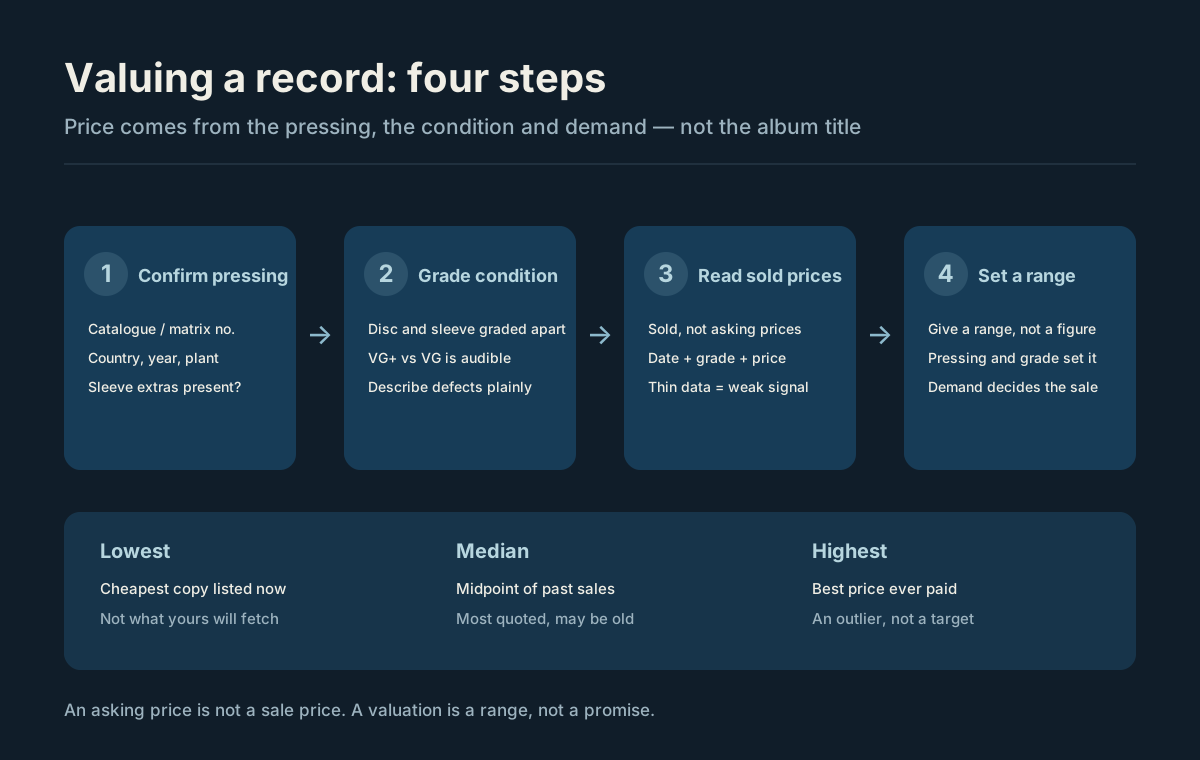
Illustration: Edition and condition determine the price floor and ceiling, while demand determines whether it sells.
Quick Overview
- The order of valuation is fixed: confirm edition, assess condition, check sales records, derive price range. If the order is scrambled, the conclusion will be off.
- On Discogs, the lowest, median, and highest prices have different meanings, and the median is the most commonly misused.
- To judge whether the median is trustworthy, look at the number of sales and sales frequency, not the size of the number itself.
- Condition determines the price floor, and demand determines the price ceiling; scarcity only means few exist, not that anyone wants them.
- The completeness of extras, original inner sleeves, obi strips, and inserts creates another gap within the same edition.
- Record the edition and condition so that the next valuation has a baseline for comparison, instead of starting from zero each time.
What Makes Valuation Difficult
The difficulty is never that you cannot find a price, but that the price you find does not correspond to the copy in your hands.
The same album may be reissued repeatedly over decades: different countries, different years, different pressing plants, different master tape sources, and even different batches in the same year. The cover may look almost identical, but prices can differ by many times. Platform search results default to grouping by album name, and the most common mistake is mistaking a reissue price for the original pressing price.
The second difficulty is that platform numbers carry historical baggage. The median is a statistical result calculated from all sales over time, which may include sales from many years ago when market heat was completely different, and may also mix in cases with entirely different condition and extras. The number itself is not the problem; the problem is that it describes "the average situation of all past sales," not "how much your current copy can sell for."
The third difficulty is self-assessing condition. Almost everyone overestimates the condition of their records: slight noise that is inaudible during normal listening can become a reason for a return in the buyer's hands. Self-assessment does not matter much when buying, but when selling it is the main source of pricing deviation. To reduce deviation, compare item by item against public grading standards rather than giving a rough impression based on feeling.
Step One: Confirm the Edition Down to the Specific Pressing
The correct starting point for valuation is the edition, not the price page. Before the edition is determined, any quote is just a comparison against the wrong sample.
The information to record includes:
- Catalog number, usually printed on the spine, label, and back cover
- Matrix / runout, meaning the etched or stamped characters in the blank area between the record label and the runout groove
- Country and year of release, as well as the copyright year printed on the label
- Pressing plant identifiers, such as plant abbreviations or specific characters in the runout
- Cover details: whether there is an obi strip, insert, poster, or original inner sleeve
- The condition of the record and cover separately
The matrix/runout deserves a separate mention: hand-etched versus stamped characters are themselves features of different pressing plants or periods, and the matrix/runout of the same album is almost never completely identical between different editions. Copy the full matrix/runout, including slashes, hyphens, and mastering engineer signature-style abbreviations, and then search; the hit rate will be much higher.
On Discogs, search first by catalog number or matrix/runout, not just by album name. Among results from an album-name search, the vast majority are not the copy in your hands. After finding candidate entries, verify year, country, and label design item by item, then confirm whether it belongs to the same pressing. If there are truly too many entries with the same name, you can narrow the range by sorting by country and year, then look at label photos one by one.
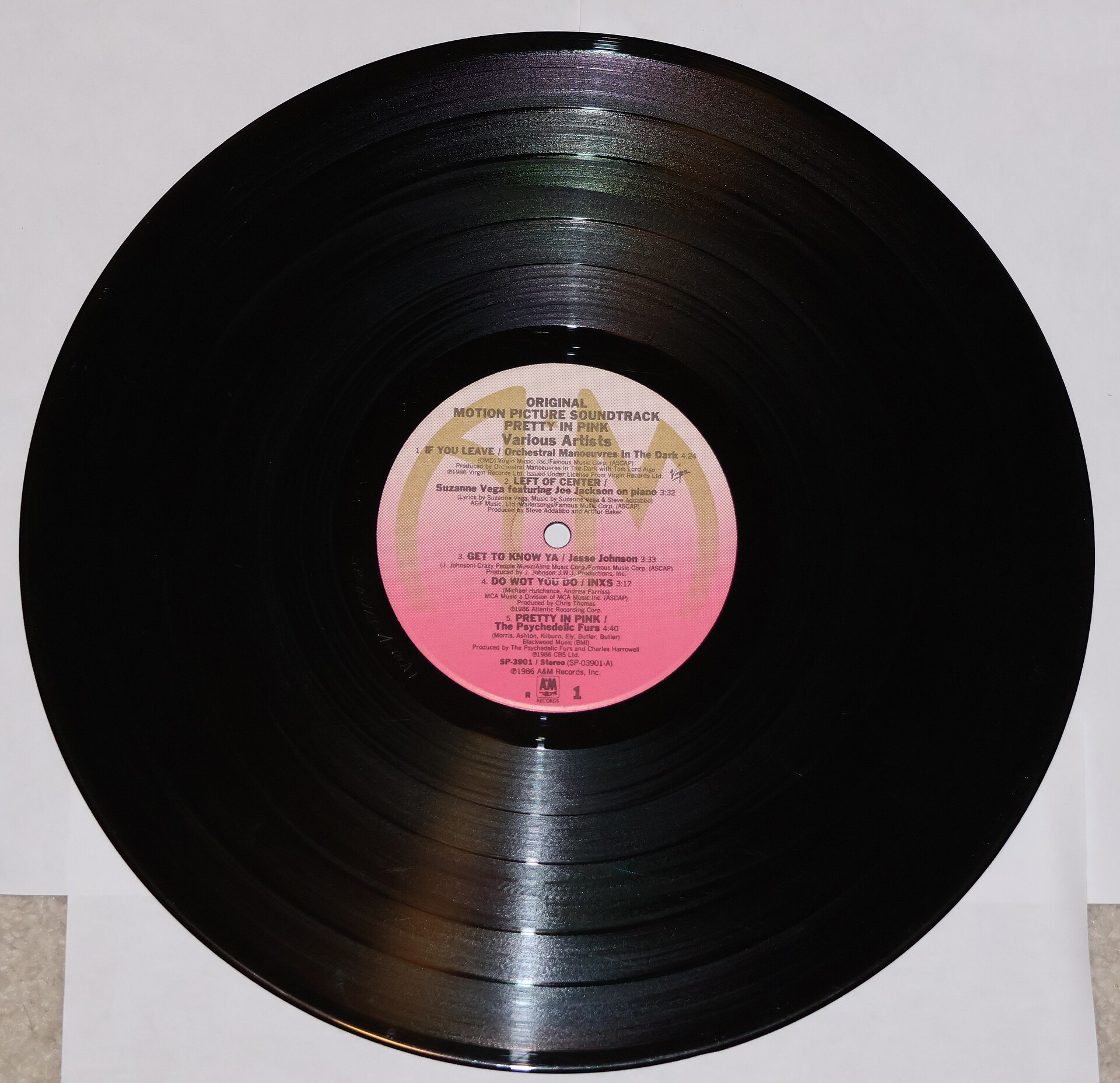
The label is the first stop for confirming the edition: the label brand, catalog number, and copyright year are all printed here.
The Three Prices on Discogs Have Different Meanings
After confirming the edition, you will usually see several numbers. They answer different questions, and mixing them up will lead to wrong conclusions.
- Lowest: The cheapest copy currently for sale. It reflects "whether anyone is willing to sell cheaply," not "whether anyone is willing to buy at this price." If it sits there without selling, that means the price may not hold.
- Median: The median of historical sale prices. It is more robust than the average and less easily skewed by extreme cases. It is the most commonly cited reference value, but it may include sales from many years ago.
- Highest: The highest historical sale. It usually comes from an exceptionally fine copy with complete extras, or from a situation where two buyers happened to compete, and it cannot be taken as an expected price.
Among these three numbers, the most easily misused is the median price: it is often read as "my record is probably worth this much," but in reality, it does not distinguish condition, does not distinguish extras, and does not distinguish the time of sale. Treating it as a rough anchor is fine; treating it as a basis for a quote will cause problems.
Discogs's condition grading guide explains the basic rules for grading and description. If you want to understand the condition field in sales records, it is worth reading first; the Goldmine system follows the same logic, just with more colloquial wording.
Individual sales records are more informative than the median price
If the platform provides individual sales records, including sale date, condition, and sale price, then it is worth more of your time than any summary number. When looking at them, you can follow these steps:
- First pick out recent sales; historical sales serve only as background, not as the main basis.
- Look at sales density: if there have only been two or three sales in the past six months, the median price has very limited reference value; if there are steady sales every month, the median price is relatively reliable.
- Establish a condition correspondence: for the same version, sale prices for different conditions form a clear gradient; find the tier close to your record's condition.
- Exclude extreme values: obvious high or low outliers should not be part of your judgment, but remember them, because they show that this version has room both to be overvalued and to be picked up as a bargain.
- Pay attention to currency and shipping: the landed cost of a cross-border sale is not equal to the number on the page; when comparing, either include landed cost for all or exclude it for all.
A practical rule of thumb is: the most common price range in sales records represents a reasonable expectation for the copy in your hands better than the highest price. The role of a range is to say "roughly where," not "exactly this number."
How condition determines the lower limit of price
Condition is not a bonus; it is the floor of the price. Assuming the same version and the same extras, each drop in condition often means a drop of one tier in sale price, and that gap is usually more direct than the gap caused by version differences.
Grade the record and the sleeve separately, then look at prices. In the Goldmine system, M, NM, VG+, VG, and G each have clear descriptions; Good does not mean "good," and VG does not mean "very good"—they correspond to the degree of audible wear. However, a G-grade record should still play through without skipping; it is a usable but not refined grade. If you are not yet familiar with this set of letters, the Vinyl Condition Grading Guide has a level-by-level explanation.
Avoid vague wording when describing condition. "Overall okay" gives the buyer no information, while "persistent crackle on track 2 of side A, side B fine" is a verifiable description and easier to support your pricing. When negotiation is needed, proactively stating problems is often more cost-effective than hiding them, because the return cost caused by hiding them is usually higher.
Two more points are often overlooked: first, sleeve grade and record grade must be written separately; when the gap between them is large, buyers will negotiate them separately. Second, issues such as groove wear, inner-sleeve marks, and slight warping are often invisible in photos but directly affect the sale price; proactively explaining them actually makes a sale more likely.
Demand is more direct than scarcity
Scarcity does not equal expensiveness. A regional record with very few copies in existence may stay at a low price for a long time if no one is looking for it; conversely, some popular albums with large pressings remain stable in price because people keep wanting to buy them. Prices in the secondhand market are ultimately determined by the people willing to pay at that moment, not by the number of copies in existence.
To judge demand, you can look at three things:
- Sales frequency: how often this version sells. High frequency means there are steady buyers paying attention.
- Number for sale: many for sale but few sales means listing prices are generally too high; few for sale but frequent sales means the price has support.
- Number of people with it on their want list: the number of people who add a version to their want list reflects potential demand, not realized demand, but it can explain why some records' listing prices never drop over time.
Looking at these three things together is more reliable than looking at any one alone. Once you understand this, you will not set a price no one will accept just because "this one is rare." Collecting motivation itself also affects the structure of demand: some people care about first pressings and master tapes, while others only care about whether they can hear the music. These two types of buyers are willing to pay different amounts. For this topic, you can read further Why I Listen to Secondhand Vinyl.
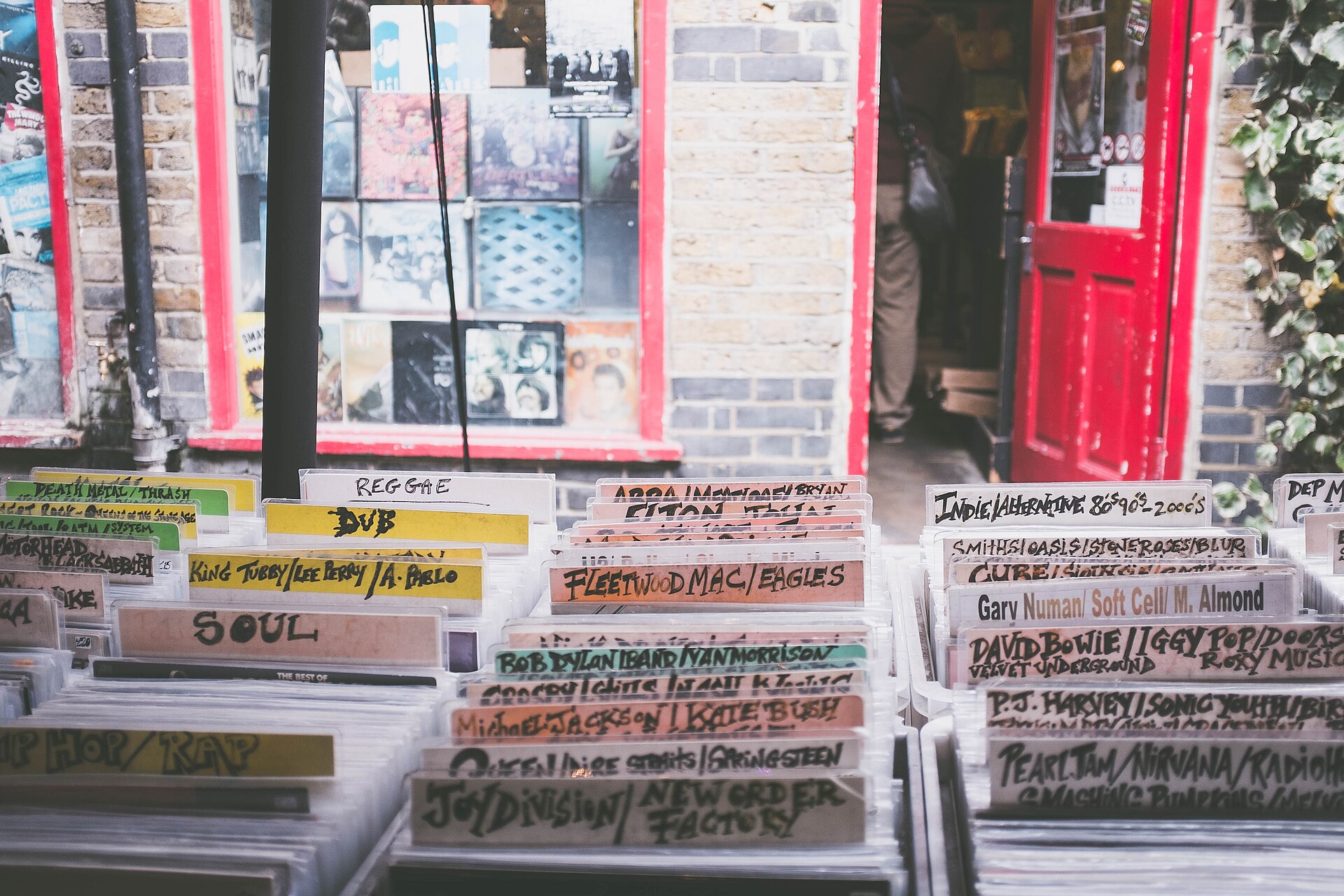
The same album title may correspond to dozens of versions, so first narrow it down by catalog number, then discuss price.
How extras and completeness affect price
Within the same version, completeness is often the second source of price differences. When checking the extras list, you can go through it item by item:
- Original inner sleeve: an original inner sleeve with label text or artwork is usually more important to buyers than a generic white sleeve.
- Inserts, posters, stickers, postcards: whether these extras are complete will noticeably change sale prices between copies of the same version.
- Obi strip: Japanese records with and without the obi strip are often treated as two different collectible objects.
- Outer sleeve and shrink wrap: an original outer sleeve and an old record that has never been opened are both part of completeness.
- Gatefold sleeve ungluing and delamination: these are deductions in sleeve grading and need to be stated separately.
It should be noted that attachments only make sense after the version has been confirmed. If the version is not determined, discussing attachments is like comparing the wrong samples. Conversely, a common version with complete attachments should not be priced as a rare version.
Three Common Mistakes in Valuation
- Using someone else's listing price as the sale price: Items listed on a page that haven't sold are not sale prices. Listing prices only indicate what the seller wants, not what the market is willing to pay.
- Ignoring version differences: Reissues and first pressings share the same album name, but their prices are completely different. Searching only by album name is almost guaranteed to lead to errors.
- Treating an isolated case as the norm: A single high-priced sale might come from excellent condition or two bidders competing, but it doesn't mean your copy is worth that amount.
There are two more easily overlooked biases: first, only looking at numbers you want to believe, forming a conclusion first and then picking evidence; second, treating the purchase price as the value—the purchase price only indicates what you paid at the time and has no necessary relation to today's market. When you find yourself doing these two things, the best approach is to stop and re-examine a different set of sales records.
Making Valuation Part of Collection Management
Valuation is not a one-time action. The record market changes, and your collection changes too. A range you look up today will become outdated after some time. A more effective approach is to record information: version details, condition of the record and sleeve, list of attachments, purchase date and price.
Once these fields are recorded, the next time you need to make a judgment, you have a baseline for comparison instead of starting from scratch each time. As the quantity grows, the time cost of repeated searches rises quickly, and that's when the value of the recording habit truly becomes apparent.
GROVV can help you organize your vinyl collection and wishlist, keeping version and condition information at your fingertips. For details, see How to Manage Vinyl Records with GROVV. When the collection is large, collection organization methods can also help reduce repetitive work. No matter what tool you use, the goal is the same: make the answer to "what version is this, and what's its condition" readily available.
Frequently Asked Questions
Can I value a record with only the album name?
No reliable conclusion can be given. The same album name may correspond to many versions, with a wide price range, and taking the middle value is meaningless. At least one of the catalog number or matrix number is needed to narrow it down to a specific version; any figure before that can only be treated as background information.
Can the median price be directly used as my selling price?
Not recommended. The median price is a statistical result of historical sales, without distinguishing condition, attachments, or sale time. A safer approach is to look at recent individual sales, find the tier close to your record's condition, and then judge based on the current number of listings. The median price is suitable for confirming "roughly what order of magnitude."
How much does the price differ if the condition is one grade lower?
There is no fixed ratio, but the difference is usually significant. Condition determines the lower limit of the price; for the same version, VG and NM sale prices often fall into different ranges. The exact difference depends on the version's popularity and the number of buyers at the time. Rather than memorizing multiples, it's better to develop the habit of "grade first, then look at sale prices for that condition."
Does "rare" mean expensive?
Not necessarily. Rarity only means few copies exist; the price also needs buyers to support it. Records that are scarce but have no demand may stay at low prices for a long time; records with large pressings but continuous demand may be more stable in price. To judge demand, you still need to look at sales frequency, number of listings, and number of people who want it.
Are sealed records always more valuable?
Not necessarily. Sealed means the record cannot be inspected, and buyers will factor that risk into the price; also, records stored sealed for a long time may develop inner sleeve marks or slight warping. Whether it's more valuable depends on the version, buyer preference, and sleeve condition—it cannot be generalized.
One final reminder: valuation gives a range, not a promise. What truly determines the price is the person willing to pay at that moment, and no one can guarantee whether that person is around today.
Image Credits
The photos in this article are from Wikimedia Commons, used under the licenses indicated for each image; the diagrams are made by GROVV.
- The label is the first stop for confirming the version: label, catalog number, and copyright year are all printed here: DiscoA340 · CC0 · Source
- The same album name may correspond to dozens of versions, so first narrow down using the catalog number, then discuss price: Yanko Peyankov peyankov · CC0 · Source

