The joy of digging in person comes from chance, but it's also a transaction marked by information asymmetry. The seller knows what's in their crates, roughly what it's worth, and which are the hot items; you only know whether the cover of the record in front of you looks good. Whoever holds more information gets closer to a fair price.
So the focus of preparation isn't "dig harder," but to finish the information work you can do at home in advance. Once you're actually there, you should be left with only three types of actions: dig in your own order, inspect by established standards, and decide to buy or not based on preset prices.
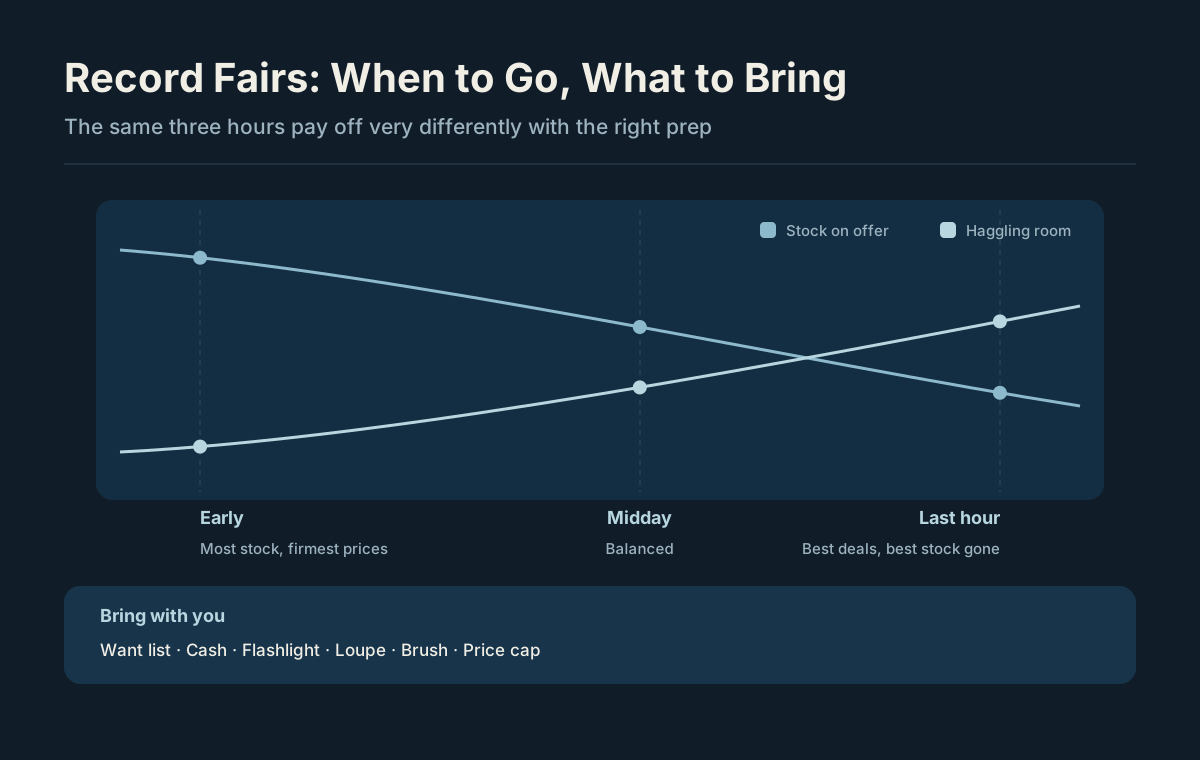
Illustration: Early session has the fullest stock and firmest prices; before closing there's more room to haggle.
Quick Overview
- Early session has the fullest stock and firmest prices; before closing there's more room to haggle, but most of the gems have already been picked. There's no perfect timing, only priorities.
- Write a list and price caps before leaving, and think clearly: "above the cap, under what circumstances am I willing to make an exception?"
- On site, only make judgments, don't do research. Treat records with uncertain versions as uncertain; don't convince yourself with "it should be a first pressing."
- You can inspect records without a turntable: look at scratches under angled light, check groove reflections, read the inner ring codes, check for warping, and evaluate the sleeve separately.
- To haggle, give reasons—pointing out specific issues is more effective than repeating "too expensive." Once agreed, don't push further.
- For cheap gems, suspect three things first: reissues, counterfeits, condition issues.
Things to Check Before You Go
Record fairs and flea markets are two different activities, and require different preparation.
Record fairs usually have clear sessions, exhibitor lists, and sections; many sellers are collectors or professional dealers, and their stock is relatively organized. Flea markets rely more on luck: the same seller's crates might contain both long-unsold dead stock and recently acquired private collections.
- Check times and sessions. When there are single-day and two-day tickets, the first day usually has the fullest stock and firmest prices; on the second day some are willing to clear stock, but popular categories have mostly been swept.
- Check the exhibitor list. If the organizer publishes a seller list, first identify the ones relevant to your targets, go straight to them when you arrive, then come back to dig slowly.
- Check weather and venue. An open-air market may close early if it rains, and outdoor humidity isn't kind to paper sleeves.
- Know your purpose. Is it to fill gaps, or just to browse? The two purposes correspond to two budgets and two levels of patience.
The real preparation is a paper list. It doesn't need to be long, but it must be specific: albums you're looking for, acceptable version ranges, and your psychological price for each. The process of writing the list is itself a rehearsal.
Tools to Bring and Budget
The principle for your toolkit is "light, sufficient, hands-free."
- Flashlight or phone light. Used to shine at an angle on the record surface—this is the most useful action on site.
- Magnifying glass. To read inner ring etchings, label details, and small copyright lines.
- Record brush or clean microfiber cloth. Not to clean the record, but to see whether scratches are dust or damage.
- Spare inner sleeves or a few protective covers, to replace torn inner sleeves and avoid further scuffing the record surface during transport.
- Portable turntable (if the venue allows). Being able to test-play on site is the strongest inspection method, but check whether there's power and whether test-playing is allowed.
- A reliable bag or box. Records are made of paper and plastic; damage from being crushed on the way home often costs more than paying a few extra bucks.
For budget, split the total into three parts: main target amount, random discovery amount, emergency amount. You can set the proportions yourself, but do keep them separate. When you mix "how much budget is left" with "is this worth it" in your judgment, the on-site atmosphere can easily decide for you.
Cash is also worth preparing separately. At markets focused on second-hand trading, some sellers only accept cash, or cash can get you a better price.
Read the Seller's Stock First, Then the Records in the Crates
Before pulling out the first record, it's worth spending a minute to judge what this seller is selling.
- Look at how the crates are organized. Sellers who sort by genre, era, or price usually have organized their stock themselves—less room for bargains but faster decisions; sellers with everything mixed and no labels have a higher chance of mispricing and misplaced items.
- Look at where the stock comes from. A personal collection clearance often has taste but severe gaps; a professional dealer's stock is more complete but prices are firmer; a seller who bought a whole lot of old stock has the loosest prices, but you need to filter yourself.
- Look at what the seller is doing. A seller chatting with friends and not actively watching you usually has more room to haggle than one who keeps staring at your hands.
- Look at the price tags. Crates with prices hastily written in pencil often mean prices can be negotiated; crates with printed uniform price tags are mostly professional sellers following market rates.
After judging, decide how deeply to dig. Spreading time evenly across all sellers is the most common waste: most crates only need a quick scan, and usually only one or two crates are worth a close look.
How to Dig On Site Without Missing Records
The efficiency gap in digging comes mainly from order, not speed.
- Finish one section at a time; don't skip crates. Skipping around is the easiest way to miss versions tucked in the middle, and good versions often sit where others have rummaged.
- Scan the sleeves first, then pull records. Use a single sliding browse to filter out obviously wrong ones; only pull out those that need a closer look.
- Put pulled records aside first. The cost of hesitating on site is often losing it; pile up candidates first, then compare them all at the end.
- Don't just look at the front. Much version information is printed on the back, the label, and the inner ring.
- Pay attention to how the crates are arranged. Many sellers put what they consider better stock in a separate crate; but truly undervalued records are often hidden in the cheapest crate.

Early birds get the best selection and the firmest prices; before closing, there's more room to negotiate, but the gems are often already picked.
A useful habit: after going through each crate, cross off the obviously unsuitable candidates instead of constantly adding to the pile. The bigger the pile, the more likely you'll end up buying everything.
How to Inspect Records Without a Turntable
Most record fairs have no listening facilities, and flea markets even less so. Therefore, the goal of on-site inspection is not to judge "whether it sounds good," but to judge "whether there are any serious flaws."
- Look at the surface with angled light. Let light sweep across the record at a very shallow angle; scratches are most visible at this angle. Distinguish between surface marks and deep scratches: the former are often light scuffs from inner sleeve friction, while the latter show a clear groove-like depth when lit from the side with a flashlight.
- Check the groove reflection. If the grooves appear overall white or gray, it usually means wear from repeated playing. That wear will turn into continuous noise during quiet passages.
- Read the matrix / runout. The inscriptions in the dead wax can confirm the version, master, and pressing plant—this is the most valuable step on site. If the matrix doesn't match the version the seller claims, it's better to leave it.
- Check for warping. Place the record flat on a level surface, or hold it up and sight along the edge to see if it's warped. Slight warping may not affect playback, but obvious unevenness can cause skipping on the tonearm.
- Check the sleeve. Seam splits, water stains, mold spots, and ring wear each represent different histories and different price discounts. Sleeve damage is often overlooked more than surface scratches, but it directly affects resale value.
- Ask if it's returnable. The seller's answer reflects their confidence in the record. Those willing to promise a return have usually checked it themselves.
One last point often overlooked by beginners: accept the premise of "incomplete information" on site. You cannot confirm the first pressing, master number, pressing plant, and true condition on the spot, so the most rational approach is to estimate uncertain items as worse than they might be, not better. Verify later at home—the cost is far lower than overpaying on site for guesswork.
Handling a Few Special Cases
- Records with no sleeve at all. First confirm that the matrix and labels are intact. Without a sleeve, you lose more than half the version information. Unless the price is extremely low and you only care about playability, it's not worth budgeting for.
- Loose discs from box sets. A single record separated from a box set often lacks the original inner sleeve and booklet, which puts you at a clear disadvantage when reselling. Unless you only want the music itself.
- Records with visible surface wear but intact grooves. Visible light scuff marks and groove wear are two different things. The former affects appearance, the latter affects sound. The criterion is the reflective texture, not the number of scratches.
- Records with crossed-out and rewritten prices. This usually means the record has been sitting in the stall for a while. It's both a bargaining opportunity and a reason to think twice: is there something wrong that made previous buyers pass?
- Freshly unpacked crates. If the seller is unpacking a box, ask if you can look through it. A crate that hasn't been picked over yet usually offers a better chance of finding good versions.
Common Traps on Site
- The word "first pressing." It costs the seller nothing to say it. When you can't verify on site, treat the version as questionable and check the matrix, sleeve details, and catalog number later.
- Overly cheap popular albums. For cheap copies of popular albums, suspect reissues, counterfeits, or condition issues first. You can refer to methods for identifying counterfeit records and keep common features in mind.
- Half-price items without sleeves. Without the original sleeve, you lose some version information and most of the collector's value—unless you only care about playability.
- Bundles sold as a set. Calculate the average price per record before deciding. Many "bundle deals" actually include records the seller couldn't sell, so the average price isn't low after all.
- Records that only play on one side. Some records have one side in decent condition and the other heavily worn, but the seller only gives an overall impression. Pull them out and look at the color difference between the two sides.
- Impulse buying. The atmosphere on site can make prices seem reasonable. Shine a flashlight over the record once more before deciding. This action can prevent a fair number of regrets.
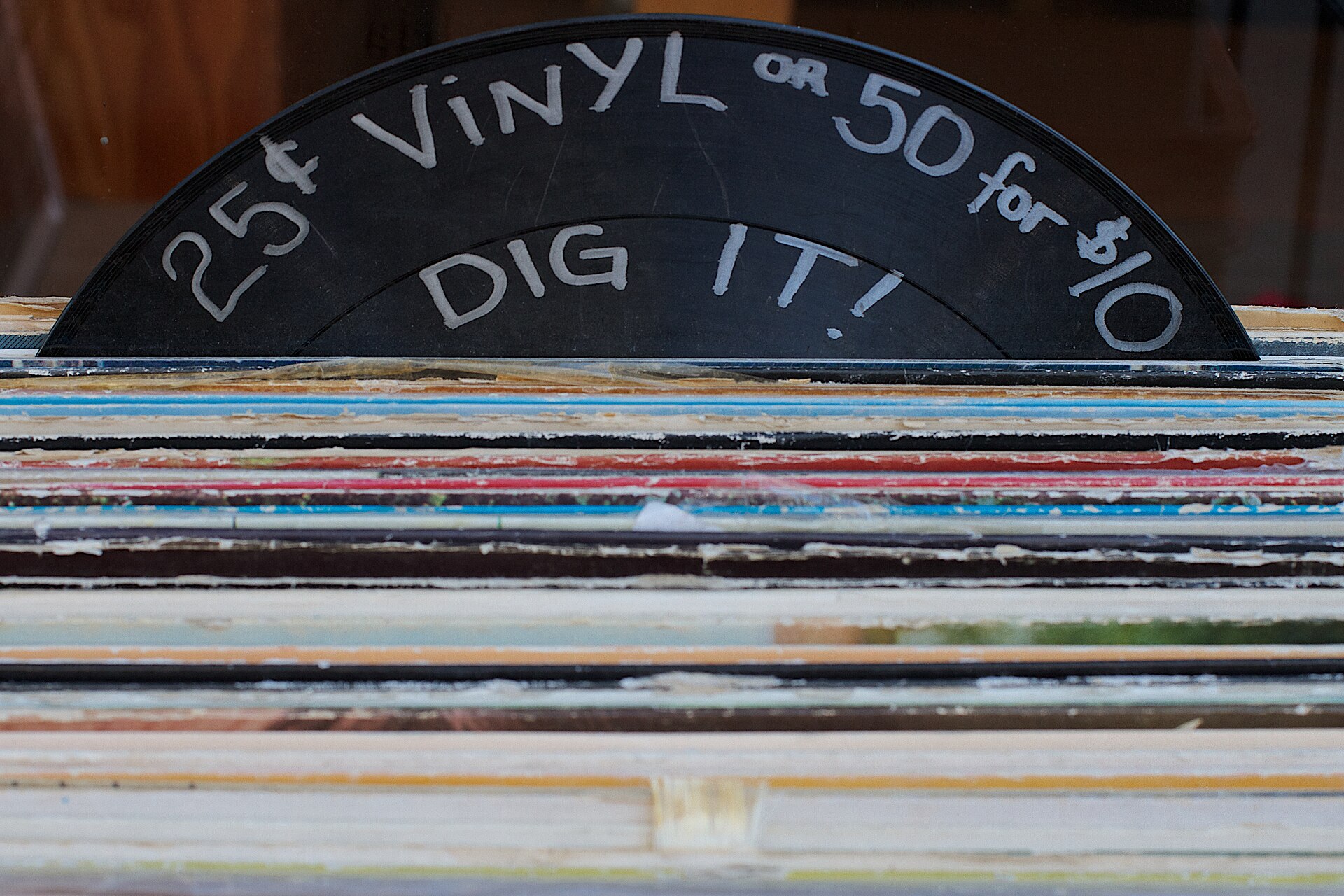
Flea market pricing is often arbitrary; shine a flashlight over the surface before deciding.
The Art of Haggling
Haggling is not a price-cutting contest, but a negotiation of exchanging information. In the record world, sellers remember you faster than you think.
- Ask for the total price first, then discuss individual items. When buying multiple records together, there's usually more room for negotiation because the seller's focus is on the total for that transaction.
- Make your offer based on specifics. Point out concrete issues, such as "there's a scratch on the inner grooves of side two" or "the sleeve is unglued at the bottom," which is far more effective than simply saying "too expensive."
- Trade certainty for certainty. Cash, immediate purchase, buying multiple records—these are your bargaining chips. Use them to get a better price; it's easier to reach an agreement than with empty haggling.
- Don't spend too long haggling over a few dollars. Your time, energy, and focus are all costs. Saving a small amount might cause you to miss better finds at the next stall.
- Once a price is agreed, don't push further. This circle is small, and reputation has real value. One uncomfortable haggling session could cost you the chance to see goods first next time.
- If it's not right, politely put it back. Saying "I'll keep looking" and returning it to the crate is a better deal than forcing a purchase.
There's a situation where you should walk away: when the seller is vague about version details but insists on a high price. This combination usually means the information doesn't add up, and it's not something you can solve by haggling.
The First Thing to Do After Buying
Clean first, then play. Market finds often have dust, mold spots, and unidentified stains on the surface. Playing them directly pushes dirt into the grooves and may accelerate stylus wear. After cleaning, do a low-volume test listen of the inner and outer grooves to check for skips, then play the whole record.
Next, record the relevant information: version, matrix number, purchase price, condition assessment, sleeve condition. This may seem tedious, but it determines your efficiency for the next dig. Knowing which versions you own helps avoid duplicate purchases; knowing how much you paid helps you quickly judge whether a similar find is reasonably priced.
Maintenance and storage also deserve advance planning. Records should be stored vertically, inner sleeves replaced, and kept away from moisture. These details determine whether you'll need to buy them all over again in a few years.
- For a unified standard for condition assessment, see the Vinyl Condition Grading Guide.
- If you're worried about counterfeits, first read How to Identify Counterfeit Vinyl Records.
- To systematically organize versions and purchase records, check out Vinyl Collection Organization.
- If you're more used to comparing prices and checking versions online, go through the Checklist for Buying Secondhand Vinyl Online first—it will change the questions you ask in person.
Frequently Asked Questions
Is it better to go early or just before closing?
They solve different problems. Early entry suits those with specific goals: the selection is fullest, and you have a chance to pick the best-condition copy. Just before closing suits those willing to accept uncertainty: there's more room to negotiate, but what's left has often been picked over. If your goal is to fill a specific gap, go early; if your goal is to expand your listening range and find bargains, you can arrive later.
If I don't have a turntable, should I avoid buying expensive records in person?
Not necessarily, but you need to make trade-offs. Lower your price expectations to a level where you'd be okay "even if there are hidden problems," or only buy from sellers who offer returns. The higher the price and the less ideal the on-site conditions, the more you should treat uncertainty as a risk discount, not as luck.
How do I haggle without offending the seller?
Turn haggling into a discussion of specific conditions. First explain how many records you plan to buy, that you'll pay cash, and that you'll close now; then point out the actual issues affecting the price. Giving the other person an acceptable way out makes an agreement more likely than simply quoting a low number, and it leaves room for future dealings.
Can I trust the condition the seller claims?
You can listen, but don't rely solely on it. Sellers usually don't have time to test-play every record; their judgment may be based on appearance rather than playback. Inspecting with a flashlight yourself costs little and yields a lot. Real disputes often arise from issues like "audible noise," which a visual check can't fully cover.
Are those extremely cheap box lots at markets worth buying?
First calculate the average price, then look at the contents. The value of a box lot usually comes from a few records in it, but the seller spreads the total cost onto you. A more practical approach is to ask to pick through it, or treat the whole box as one unit and make an offer based on "it's worth it if there are two or three I want in there."
The joy of digging in person lies in discovery, but what turns discovery into a collection is the organization afterward. Go out with a want list and a flashlight, come home with verifiable records, and you'll find the same market is worth visiting many times.
Image Credits
The photos in this article are from Wikimedia Commons, used under the licenses indicated for each image; the diagrams are created by GROVV.
- Early in the day the selection is fullest and prices are firmest; before vendors pack up there's more room to negotiate, but the best finds have often already been picked over: Artificial Photography artificialphotography · CC0 · Source
- Pricing at markets is often arbitrary, so shine a flashlight over the record surface first before deciding: cogdogblog · CC BY 2.0 · Source

